Description
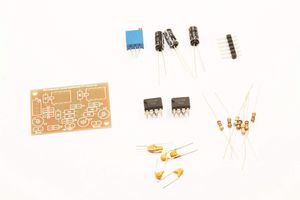
The proposed filter is designed to receive Telegraph signals. It consists of a series of low-pass filter (LPF, DA1) and high-pass filter (HPF, DA2), which are built on operational amplifiers IC 708. The parameters of the frequency-determining elements of the filters are chosen so that the frequency response of both filters has a noticeable rise at the quasi-resonance frequencies F0 (see Fig.). Since the LPF and the HPF are connected in series, together they form a bandpass filter. The frequency of the quasi-resonance of the HPF is fixed and equal to 800 Hz, and the frequency of the quasi-resonance of the LPF can be changed by the tuning resistor R1. Each filter has a quasi-resonance frequency transmission coefficient of about 15. If set frequency 750 Hz of quasi-resonance LPF by R1, the filter as a whole will have a form, which is shown in Fig.2 at the bottom left. The transmission coefficient in the maximum frequency response (corresponds to about 770 Hz) will be about 160. If it is set to 700 Hz, the frequency response will have the form shown in Fig. at the bottom right. The transmission coefficient in the highs of the frequency response will be about 60. In most cases, the second option of setting the filter, which provides a wider bandwidth, is preferable, since too narrow-band filters tend to "ring", require very stable heterodynes in the equipment of both operators. The filter is powered from a source with a voltage of DC 9-12 V. The constant bias on the non-inverting inputs of operational amplifiers (half the supply voltage) sets the voltage to R7, R8.
Active CW Audio Low-Pass Filter. Soldering Project KIT
Current Price
$10
Average
$10
Min Price
$10
Max Price
$10
Description
The proposed filter is designed to receive Telegraph signals. It consists of a series of low-pass filter (LPF, DA1) and high-pass filter (HPF, DA2), which are built on operational amplifiers IC 708. The parameters of the frequency-determining elements of the filters are chosen so that the frequency response of both filters has a noticeable rise at the quasi-resonance frequencies F0 (see Fig.). Since the LPF and the HPF are connected in series, together they form a bandpass filter. The frequency of the quasi-resonance of the HPF is fixed and equal to 800 Hz, and the frequency of the quasi-resonance of the LPF can be changed by the tuning resistor R1. Each filter has a quasi-resonance frequency transmission coefficient of about 15. If set frequency 750 Hz of quasi-resonance LPF by R1, the filter as a whole will have a form, which is shown in Fig.2 at the bottom left. The transmission coefficient in the maximum frequency response (corresponds to about 770 Hz) will be about 160. If it is set to 700 Hz, the frequency response will have the form shown in Fig. at the bottom right. The transmission coefficient in the highs of the frequency response will be about 60. In most cases, the second option of setting the filter, which provides a wider bandwidth, is preferable, since too narrow-band filters tend to "ring", require very stable heterodynes in the equipment of both operators. The filter is powered from a source with a voltage of DC 9-12 V. The constant bias on the non-inverting inputs of operational amplifiers (half the supply voltage) sets the voltage to R7, R8.
Price will be lower
in next 2 weeks
in next 2 weeks
According to the data, price will be lower in next two weeks, so not waste your money and track better price!
Product review & video
welcome back to dx explorer for one more video in the today's video i'm going to talk about a very simple lcd cw audio filter technically supposed to be a passive audio filter that you place between the output of your receiver and your headphones or a speaker if the receiver has enough power to drive a speaker and i've built that one based on a very simple inductor and capacitor i'm going to show you the schematic in a little bit and i'm going to explain everything but the disadvantage using this passive audio filter between the output of your receiver and your headphones is that it's cutting a lot of the audio that goes to to your ears so um i wanted to try and see if i can manage to transform my external lm386 amplifier that i'm using to power my speaker uh for the receiver and see if i can transform this simple passive audio filter into an active audio filter placing it between the r


Similar products