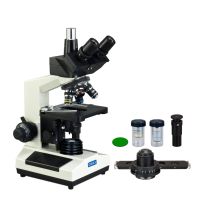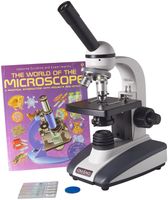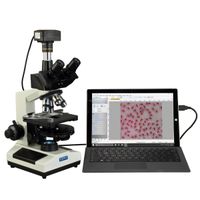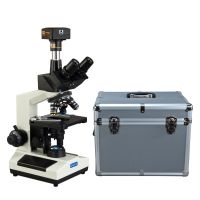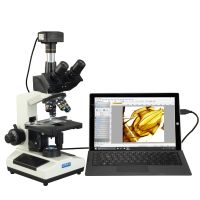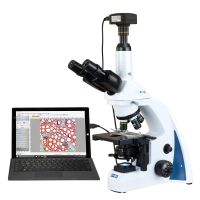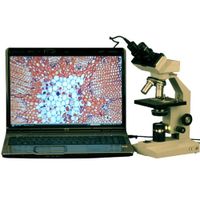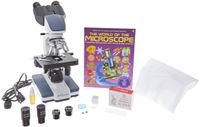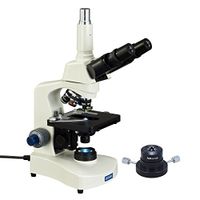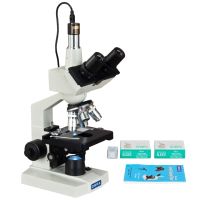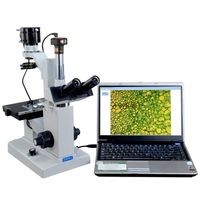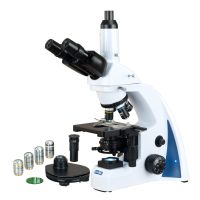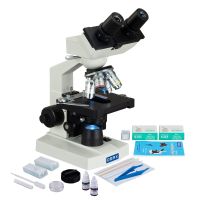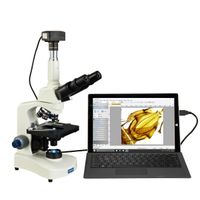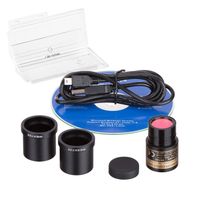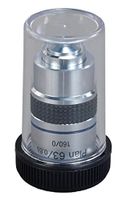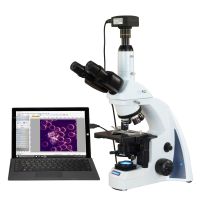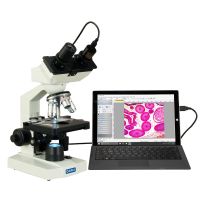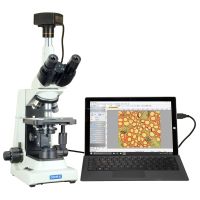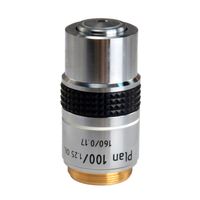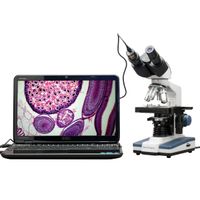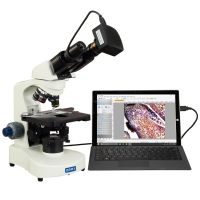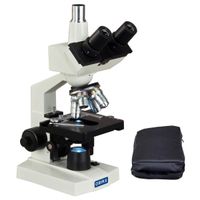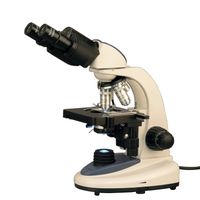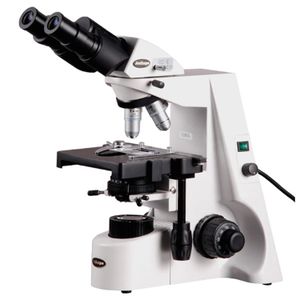
The AmScope B690C-PL compound Siedentopf binocular microscope has interchangeable pairs of 10x super-widefield and 25x super-widefield eyepieces, a forward-facing nosepiece with four DIN infinity plan objectives, Brightfield halogen illumination, and a double-layer mechanical stage with a stage stop to protect slides and objectives from damage. The Siedentopf binocular head has interchangeable pairs of WH10x and WH25x eyepieces with 55 to 75mm Siedentopf inter-pupillary adjustment, a fixed 30-degree vertical inclination to reduce eye and neck strain, and a 360-degree rotation capability to provide a more comprehensive view and enable sharing. Dioptric adjustment accommodates individual eye-strength differences. The mechanical tube length is 6-5/16" (160mm). The reverse-mounted revolving nosepiece has 4x, 10x, 40xS, and 100xS (oil) DIN infinity plan objectives that provide focus over the entire range of the viewing field, and a longer working distance for improved focus when auxiliary components are utilized. The 40xS objective is spring loaded to prevent slide damage when focusing. The 100xS spring-loaded oil objective provides increased resolution over a standard objective. A compound microscope is used for inspection and dissection of specimens when two-dimensional images are desired.
The microscope has Brightfield illumination. Brightfield (BF) illumination allows the specimen to absorb light, resulting in a dark image on a light background. Halogen illumination provides bright light in a concentrated path, and a Kohler condenser focuses and centers the light path using two iris diaphragms, providing optimum contrast and resolution. The graduated double-layer mechanical stage, with 1mm stage divisions, locks the slide into place and provides precise slide manipulation along the X- and Y-axis to allow coordinates to be recorded, enabling the viewer to return to a specific location on the slide. A stage stop prevents the stage or specime
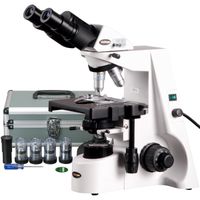
AmScope B690C-PL Siedentopf Binocular Compound Microscope, 40X-2500X Magnification, WH10x and WH25x Super-Widefield Eyepieces, Infinity Plan Objectives, Brightfield, Kohler Condenser, Double-Layer Mechanical Stage
The AmScope B690C-PL compound Siedentopf binocular microscope has interchangeable pairs of 10x super-widefield and 25x super-widefield eyepieces, a forward-facing nosepiece with four DIN infinity plan objectives, Brightfield halogen illumination, and a double-layer mechanical stage with a stage stop to protect slides and objectives from damage. The Siedentopf binocular head has interchangeable pairs of WH10x and WH25x eyepieces with 55 to 75mm Siedentopf inter-pupillary adjustment, a fixed 30-degree vertical inclination to reduce eye and neck strain, and a 360-degree rotation capability to provide a more comprehensive view and enable sharing. Dioptric adjustment accommodates individual eye-strength differences. The mechanical tube length is 6-5/16" (160mm). The reverse-mounted revolving nosepiece has 4x, 10x, 40xS, and 100xS (oil) DIN infinity plan objectives that provide focus over the entire range of the viewing field, and a longer working distance for improved focus when auxiliary components are utilized. The 40xS objective is spring loaded to prevent slide damage when focusing. The 100xS spring-loaded oil objective provides increased resolution over a standard objective. A compound microscope is used for inspection and dissection of specimens when two-dimensional images are desired.
The microscope has Brightfield illumination. Brightfield (BF) illumination allows the specimen to absorb light, resulting in a dark image on a light background. Halogen illumination provides bright light in a concentrated path, and a Kohler condenser focuses and centers the light path using two iris diaphragms, providing optimum contrast and resolution. The graduated double-layer mechanical stage, with 1mm stage divisions, locks the slide into place and provides precise slide manipulation along the X- and Y-axis to allow coordinates to be recorded, enabling the viewer to return to a specific location on the slide. A stage stop prevents the stage or specime
in next 2 weeks
By clicking "Accept All", you consent to our use of cookies.