- HomeElectronicsCamera & PhotoBinoculars & ScopesMicroscopesCompound MicroscopesCompound Trinocular Microscopes
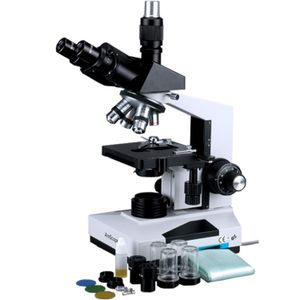
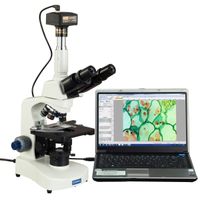
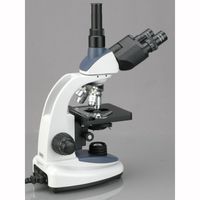
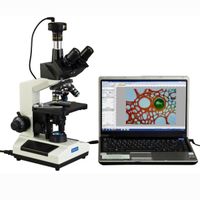
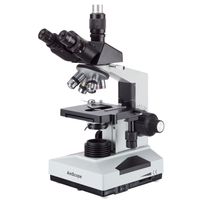
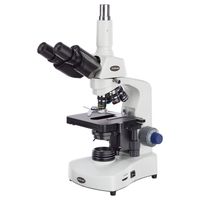
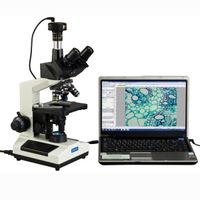
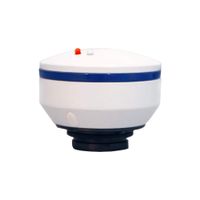
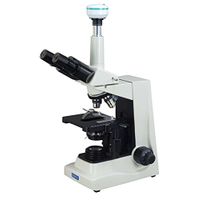
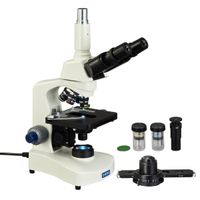
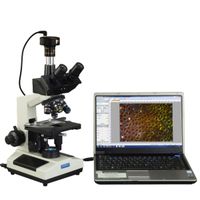
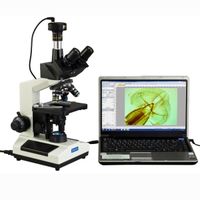
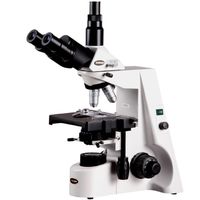
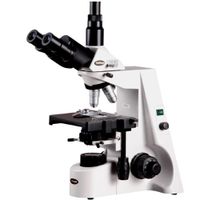
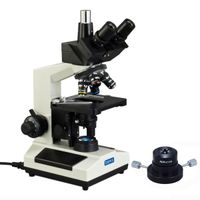
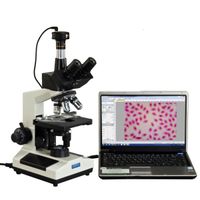
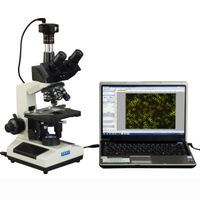
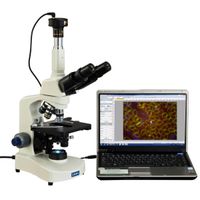
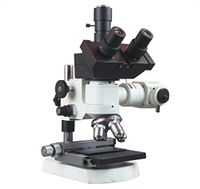
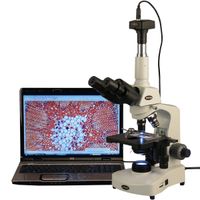
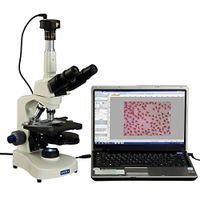
The AmScope T490A compound trinocular microscope has a sliding head, interchangeable pairs of 10x widefield and 16x widefield eyepieces, a forward-facing nosepiece with four DIN achromatic objectives, Brightfield halogen illumination, and a double-layer mechanical stage with a stage stop to protect slides and objectives from damage. The trinocular viewing head has a vertical camera mount and a compensation-free binocular viewing head with interchangeable pairs of WF10x and WF16x eyepieces and sliding head to adjust inter-pupillary distance, a fixed 30-degree vertical inclination to reduce eye and neck strain, and a 360-degree rotation capability to provide a more comprehensive view and enable sharing. A Siedentopf binocular head enables the viewer to change the interpupillary distance without changing the tube length, eliminating the need to re-focus the image. It has an interpupillary range of 55 to 75mm to accommodate individual eye differences, and bi-lateral dioptric adjustment accommodates individual eye-strength differences. The vertical trinocular port accepts a camera with a 23mm or C-Mount adapter (camera sold separately). The forward-facing nosepiece has 4x, 10x, 40xS (spring), and 100xS (spring, oil) DIN achromatic optical-glass objectives that combine with the eyepieces to provide color correction of magnified images. The 40xS objective is spring loaded to prevent slide damage when focusing. The 100xS spring-loaded oil-immersion objective uses oil between the specimen and the objective lens to provide increased resolution over a standard objective. A compound microscope is used for inspection and dissection of specimens when two-dimensional images are desired.
The microscope has lower (transmitted, diascopic) Brightfield illumination that transmits light up through the specimen for enhanced visibility of translucent and transparent objects. Brightfield (BF) illumination allows the specimen to absorb light, resulting in a dark
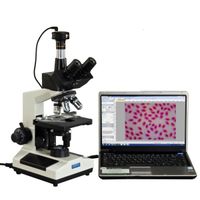
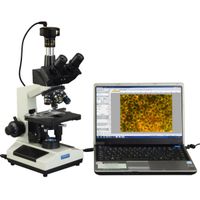
AmScope T490A Compound Trinocular Microscope, WF10x and WF16x Eyepieces, 40X-1600X Magnification, Brightfield, Halogen Illumination, Abbe Condenser, Double-Layer Mechanical Stage, Sliding Head, High-Resolution Optics
The AmScope T490A compound trinocular microscope has a sliding head, interchangeable pairs of 10x widefield and 16x widefield eyepieces, a forward-facing nosepiece with four DIN achromatic objectives, Brightfield halogen illumination, and a double-layer mechanical stage with a stage stop to protect slides and objectives from damage. The trinocular viewing head has a vertical camera mount and a compensation-free binocular viewing head with interchangeable pairs of WF10x and WF16x eyepieces and sliding head to adjust inter-pupillary distance, a fixed 30-degree vertical inclination to reduce eye and neck strain, and a 360-degree rotation capability to provide a more comprehensive view and enable sharing. A Siedentopf binocular head enables the viewer to change the interpupillary distance without changing the tube length, eliminating the need to re-focus the image. It has an interpupillary range of 55 to 75mm to accommodate individual eye differences, and bi-lateral dioptric adjustment accommodates individual eye-strength differences. The vertical trinocular port accepts a camera with a 23mm or C-Mount adapter (camera sold separately). The forward-facing nosepiece has 4x, 10x, 40xS (spring), and 100xS (spring, oil) DIN achromatic optical-glass objectives that combine with the eyepieces to provide color correction of magnified images. The 40xS objective is spring loaded to prevent slide damage when focusing. The 100xS spring-loaded oil-immersion objective uses oil between the specimen and the objective lens to provide increased resolution over a standard objective. A compound microscope is used for inspection and dissection of specimens when two-dimensional images are desired.
The microscope has lower (transmitted, diascopic) Brightfield illumination that transmits light up through the specimen for enhanced visibility of translucent and transparent objects. Brightfield (BF) illumination allows the specimen to absorb light, resulting in a dark
in next 2 weeks
By clicking "Accept All", you consent to our use of cookies.