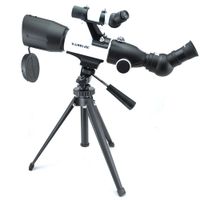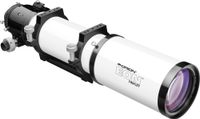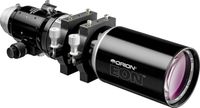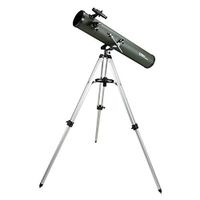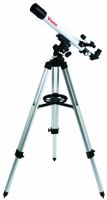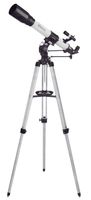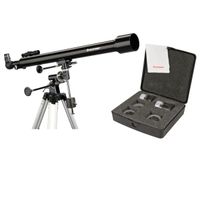
Refractors are known for their crisp, high contrast views of the Moon and planets and the Astromaster 90 delivers sharp views right out of the box. The low power 20mm eyepiece (50X magnification) nicely frames the moon, while the high power 10mm eyepiece (100X magnification) delivers a crisp close up image full of detail. The sharp Achromatic optics of the Astromaster 90AZ show me memorable views night after night. On a moonless night I like the way the 20mm eyepiece frames the ghostly glow of the Orion Nebula. Zooming in with the 10mm eyepiece, I can easily pick out all four stars of the Orion Nebula’s embedded quadruple star the Trapezium.
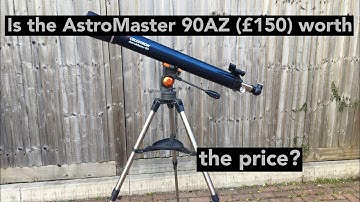
The AstroMaster 90 AZ also features a newly designed Alt-Azimuth mount and tripod. The tripod comes fully assembled, and the telescope simply clamps into a standard dovetail. This new tripod seems reasonably solid, I had no trouble focusing on the Moon and stars even with the high power eyepiece. An Alt-azimuth mount, of course, is best used at low to medium powers because it does not track the motion of the stars. As soon as you get the Moon centered in the eyepiece, it starts drifting toward the edge-this is caused by rotation of the Earth. Celestial objects will stay in the low power field of view for three or four minutes, but with a high power eyepiece they may d
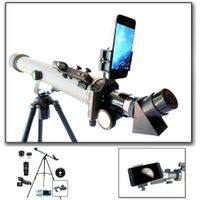
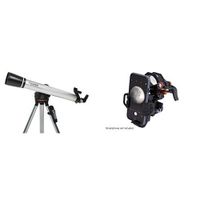
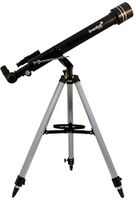
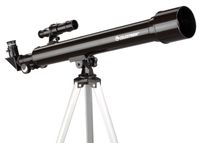
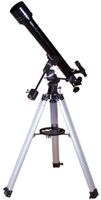
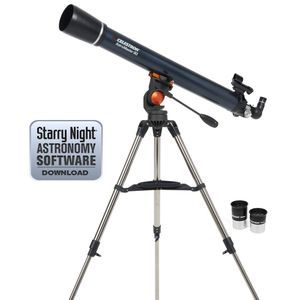
Celestron 21063 AstroMaster 90 AZ Refractor Telescope
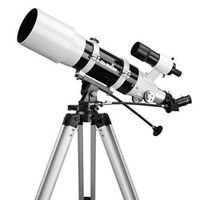
Refractors are known for their crisp, high contrast views of the Moon and planets and the Astromaster 90 delivers sharp views right out of the box. The low power 20mm eyepiece (50X magnification) nicely frames the moon, while the high power 10mm eyepiece (100X magnification) delivers a crisp close up image full of detail. The sharp Achromatic optics of the Astromaster 90AZ show me memorable views night after night. On a moonless night I like the way the 20mm eyepiece frames the ghostly glow of the Orion Nebula. Zooming in with the 10mm eyepiece, I can easily pick out all four stars of the Orion Nebula’s embedded quadruple star the Trapezium.
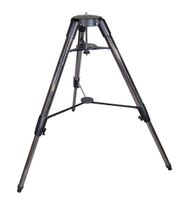
The AstroMaster 90 AZ also features a newly designed Alt-Azimuth mount and tripod. The tripod comes fully assembled, and the telescope simply clamps into a standard dovetail. This new tripod seems reasonably solid, I had no trouble focusing on the Moon and stars even with the high power eyepiece. An Alt-azimuth mount, of course, is best used at low to medium powers because it does not track the motion of the stars. As soon as you get the Moon centered in the eyepiece, it starts drifting toward the edge-this is caused by rotation of the Earth. Celestial objects will stay in the low power field of view for three or four minutes, but with a high power eyepiece they may d
in next 2 weeks