Description
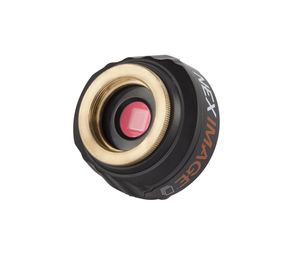
Celestron offers a wide array of high-quality, affordable, and user-friendly planetary imagers! Click here to learn more on how to choose an imager that’s right for you. Capture high-resolution planetary, lunar and solar images with the NexImage Burst Solar System Imager. This innovative camera is easy enough for a beginner to use, but features one of the best CMOS sensors available for astroimaging. It’s compatible with any computerized telescope or a non-computerized telescope with a motor drive for tracking celestial objects. Combined with the included software package, NexImage Burst brings out tremendous detail and produces images rivaling those taken with astronomical cameras costing hundreds more. Ultra-Sensitive Aptina AR0132 CMOS Sensor CMOS technology is emerging as the hottest trend in imaging, and Aptina’s AR0132 sensor leads the way. This updated version of the popular MT9M034 sensor offers the perfect combination of speed, sensitivity, and value. You won’t find the Aptina AR0132 sensor for a better price anywhere than NexImage Burst. NexImage Burst Color is a one-shot color camera, allowing you to capture full-color images instantly. There's no need to image the same target multiple times to capture different colors. You also won't need to invest in filters and a filter wheel. A Great Choice for Those New to Imaging Getting started with NexImage Burst is as easy as pointing your telescope at the Moon, Sun, or a planet and recording a video. For the sharpest possible images, NexImage Burst can record more than 120 frames per second when subframed. The included software analyzes each frame of video, throws away the ones affected by atmospheric turbulence, and perfectly aligns the best frames. The result is a bright, clear astroimage with impressive detail. Solar system imaging with NexImage Burst is a great way to enjoy the hobby of astroimaging if you live in a light-polluted area. If you can see the planet the sky,
Celestron 95518 NexImage Burst Color (Black)
Price is below average
Current Price
$141.7
Average
$182.17
Min Price
$141.7
Max Price
$279.95
Price dynamics
22%
Description
Celestron offers a wide array of high-quality, affordable, and user-friendly planetary imagers! Click here to learn more on how to choose an imager that’s right for you. Capture high-resolution planetary, lunar and solar images with the NexImage Burst Solar System Imager. This innovative camera is easy enough for a beginner to use, but features one of the best CMOS sensors available for astroimaging. It’s compatible with any computerized telescope or a non-computerized telescope with a motor drive for tracking celestial objects. Combined with the included software package, NexImage Burst brings out tremendous detail and produces images rivaling those taken with astronomical cameras costing hundreds more. Ultra-Sensitive Aptina AR0132 CMOS Sensor CMOS technology is emerging as the hottest trend in imaging, and Aptina’s AR0132 sensor leads the way. This updated version of the popular MT9M034 sensor offers the perfect combination of speed, sensitivity, and value. You won’t find the Aptina AR0132 sensor for a better price anywhere than NexImage Burst. NexImage Burst Color is a one-shot color camera, allowing you to capture full-color images instantly. There's no need to image the same target multiple times to capture different colors. You also won't need to invest in filters and a filter wheel. A Great Choice for Those New to Imaging Getting started with NexImage Burst is as easy as pointing your telescope at the Moon, Sun, or a planet and recording a video. For the sharpest possible images, NexImage Burst can record more than 120 frames per second when subframed. The included software analyzes each frame of video, throws away the ones affected by atmospheric turbulence, and perfectly aligns the best frames. The result is a bright, clear astroimage with impressive detail. Solar system imaging with NexImage Burst is a great way to enjoy the hobby of astroimaging if you live in a light-polluted area. If you can see the planet the sky,
Price will be lower
in next 2 weeks
in next 2 weeks
According to the data, price will be lower in next two weeks, so not waste your money and track better price!
Product review & video
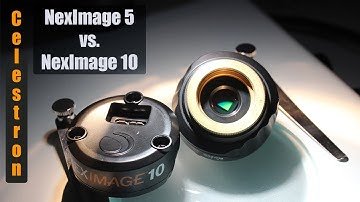
hey everyone this is Lyman in today's video I'm going to be comparing the celestron Mex image 5 with the next image 10 see obviously the differences in them primarily what 5 megapixels does so this is obviously a 10 megapixel camera this is a 5 just how much difference does a 5 megapixel camera made now the next image 10 does have some other things going for it which might make it a little better so I'm not sure how fair of a fight this is but we're going to compare them anyway in CL the next image 5 compares to the 10 so I'm going to compare these two cameras using a microscope now something you probably didn't know about me is I have my bachelor's degree in biology and I love looking at botanical and biological specimens under the microscope but I think it's a really great way to compare these 2 cameras because when you're imaging planets you're usually not using the full resolution o