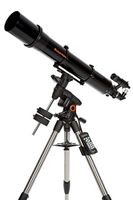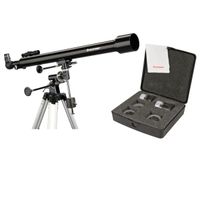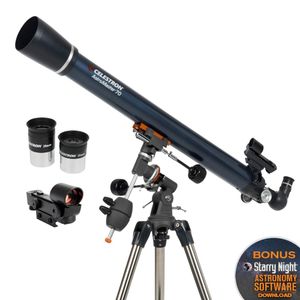
The AstroMaster 70 EQ features very good optical performance. Achromatic refractors have a two piece objective lens, the second lens element compensates for “chromatic aberration”, the false color or blue fringes seen in low cost telescopes. In daylight tests I see very little blue fringing with the standard equipment 10mm eyepiece (90X magnification), and none at all with the 20mm eyepiece (45X). Stars and planets show up very nicely with the AstroMaster 70. The bright double star Castor, one of the “twins” in the constellation Gemini, is cleanly split at 90X with the 10mm eyepiece. When I tried an optional 6mm Plossl eyepiece for a magnification of 150X, I was treated to lovely views of Saturn’s rings and the little orange disk of Mars. My view of the Moon was delightfully crisp and clear; the 20mm eyepiece nicely frames the Lunar disk, and using the 10mm eyepiece I could easily see mountain peaks and terraced walls inside the crater Copernicus.
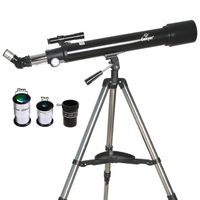
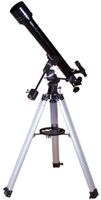
The AstroMaster 70 EQ also features a newly designed tripod with 1.25 inch stainless steel legs. This new tripod holds the telescope firmly; I had no trouble focusing even with a high power eyepiece. The equatorial mount is a little more complicated to balance and align than the AstroMaster 70 AZ , but the reward is better slow motion control and tracking at magnifications over 100X. Simply point the equatorial axis at Polaris, the North Star, and the telescope tracks celestial objects by turning one slow motion knob. This makes it much easier to use a high power eyepiece while viewing the M
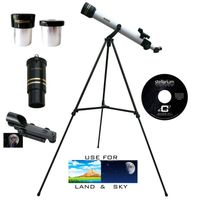
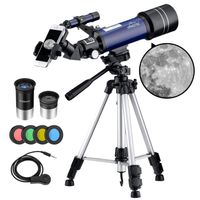
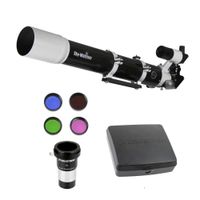
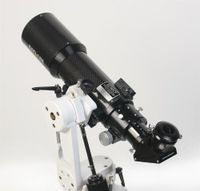
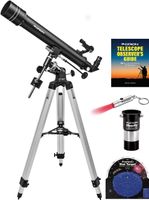
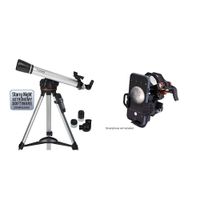
Celestron - AstroMaster 70EQ Refractor Telescope - Refractor Telescope for Beginners - Fully-Coated Glass Optics - Adjustable-Height Tripod - BONUS Astronomy Software Package
The AstroMaster 70 EQ features very good optical performance. Achromatic refractors have a two piece objective lens, the second lens element compensates for “chromatic aberration”, the false color or blue fringes seen in low cost telescopes. In daylight tests I see very little blue fringing with the standard equipment 10mm eyepiece (90X magnification), and none at all with the 20mm eyepiece (45X). Stars and planets show up very nicely with the AstroMaster 70. The bright double star Castor, one of the “twins” in the constellation Gemini, is cleanly split at 90X with the 10mm eyepiece. When I tried an optional 6mm Plossl eyepiece for a magnification of 150X, I was treated to lovely views of Saturn’s rings and the little orange disk of Mars. My view of the Moon was delightfully crisp and clear; the 20mm eyepiece nicely frames the Lunar disk, and using the 10mm eyepiece I could easily see mountain peaks and terraced walls inside the crater Copernicus.
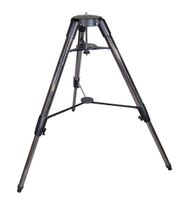
The AstroMaster 70 EQ also features a newly designed tripod with 1.25 inch stainless steel legs. This new tripod holds the telescope firmly; I had no trouble focusing even with a high power eyepiece. The equatorial mount is a little more complicated to balance and align than the AstroMaster 70 AZ , but the reward is better slow motion control and tracking at magnifications over 100X. Simply point the equatorial axis at Polaris, the North Star, and the telescope tracks celestial objects by turning one slow motion knob. This makes it much easier to use a high power eyepiece while viewing the M
in next 2 weeks