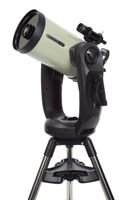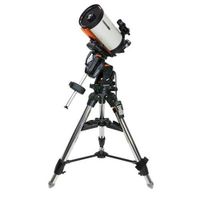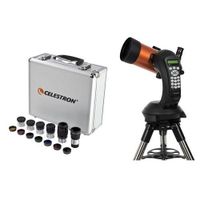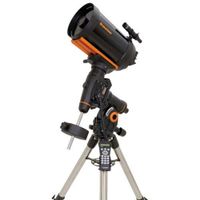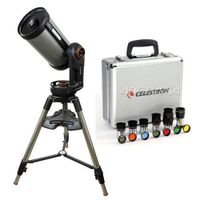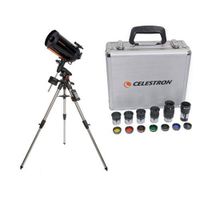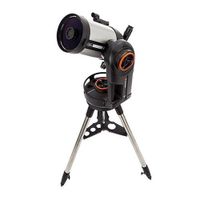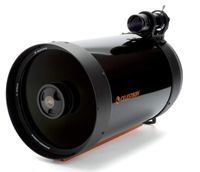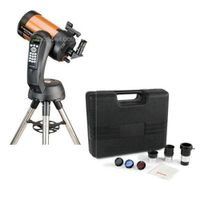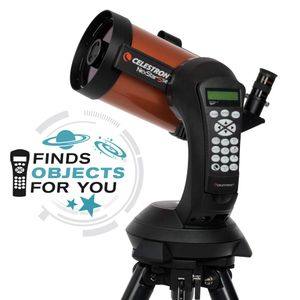
The excellent optics of Celestron's classic C5 Schmidt-Cassegrain telescope have been updated with premium Starbright XLT optical coatings. This telescope consistently delivers crisp, high contrast views of the moon, the planets, and brighter deep space objects. The standard equipment 25mm plossl eyepiece produces a magnification of 50x, powerful enough to show the rings of Saturn, the cloud bands of Jupiter, and the changing face of the Lunar disk. Optional eyepieces can be added to bring out significantly more detail. I like to use a 12.5mm plossl (100x magnification) or a 7.5mm Ultrascopic eyepiece (166x) for high power views of the planets. With the 7.5mm Ultrascopic eyepiece I can usually see the Cassini Division in Saturn's rings and cloud bands on the planet itself. I like to use a 32mm plossl eyepiece for great low power views of deep space highlights like the Orion Nebula or the Double Cluster in Perseus.
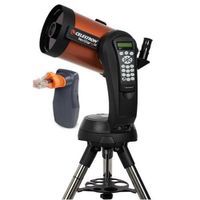
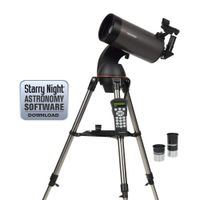
The NexStar 5 SE package also includes a sturdy adjustable tripod, a motorized alt-azimuth mount, and the NexStar hand held computer controller. You won't need a GPS receiver or star charts to operate this telescope. The SkyAlign procedure is easy to use, and experienced observers will like the two-star align and solar-system align options because they are even quicker to set up. The steel tripod and alt-azimuth mount provide a solid base for the NexStar 5 SE. Vibration is not a problem, even while focusing at high power. The computerized tracking is also very good, easily keeping planets in the field of a high power eyepiece. The disadvantage of a computerized telescope, of course, is battery consumption. I like to use a rechargeable Celes
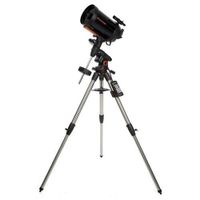
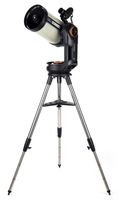
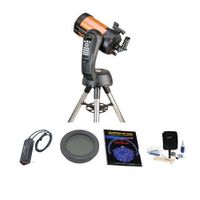
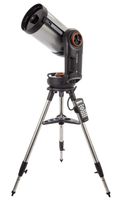
Celestron NexStar 5 SE Telescope
The excellent optics of Celestron's classic C5 Schmidt-Cassegrain telescope have been updated with premium Starbright XLT optical coatings. This telescope consistently delivers crisp, high contrast views of the moon, the planets, and brighter deep space objects. The standard equipment 25mm plossl eyepiece produces a magnification of 50x, powerful enough to show the rings of Saturn, the cloud bands of Jupiter, and the changing face of the Lunar disk. Optional eyepieces can be added to bring out significantly more detail. I like to use a 12.5mm plossl (100x magnification) or a 7.5mm Ultrascopic eyepiece (166x) for high power views of the planets. With the 7.5mm Ultrascopic eyepiece I can usually see the Cassini Division in Saturn's rings and cloud bands on the planet itself. I like to use a 32mm plossl eyepiece for great low power views of deep space highlights like the Orion Nebula or the Double Cluster in Perseus.
The NexStar 5 SE package also includes a sturdy adjustable tripod, a motorized alt-azimuth mount, and the NexStar hand held computer controller. You won't need a GPS receiver or star charts to operate this telescope. The SkyAlign procedure is easy to use, and experienced observers will like the two-star align and solar-system align options because they are even quicker to set up. The steel tripod and alt-azimuth mount provide a solid base for the NexStar 5 SE. Vibration is not a problem, even while focusing at high power. The computerized tracking is also very good, easily keeping planets in the field of a high power eyepiece. The disadvantage of a computerized telescope, of course, is battery consumption. I like to use a rechargeable Celes
in next 2 weeks