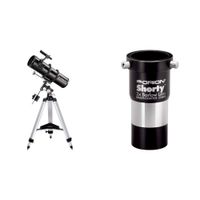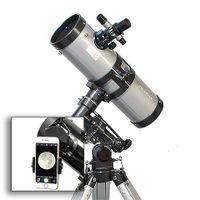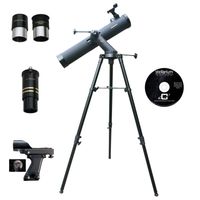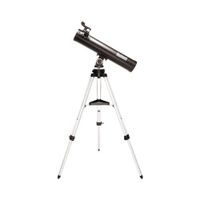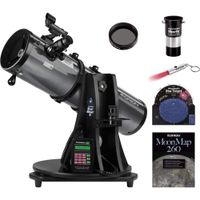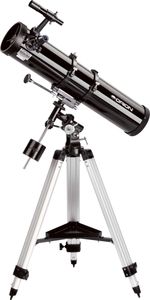
The Orion SpaceProbe 130 EQ Reflector with its Explorer II eyepieces serves up bright, clear images of the Moon, the planets, and even deep space objects like star clusters and galaxies. The 25mm eyepiece magnifies the image by 36 times; when I look at the Pleiades or Seven Sisters cluster at 36X the SpaceProbe 130 shows me a bright open cluster with dozens of point-like stars filling the field of view. When I use the 10mm eyepiece (90X magnification) the lunar disk fills the field of view and the rings of Saturn are plainly resolved. And when I use an optional Ultima 2X Barlow with the 10mm eyepiece for 180X magnification I can see the cloud bands of Jupiter and pick out individual stars in bright globular clusters like M13.
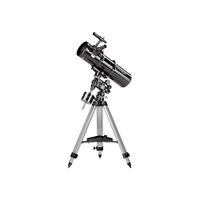
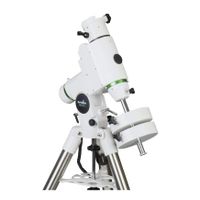
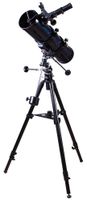
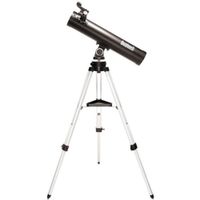
The EQ2 equatorial mount included with the Orion SpaceProbe 130 EQ Reflector comes partially assembled, but it shouldn’t take long to set up. The trick to using an equatorial mount is to point the polar axis at Polaris, the North Star. Once the mount is aligned and balanced, the telescope tracks stars and planets at high power with just a turn of one slow motion knob. You can even add an optional motor drive for hands free tracking.
The Orion SpaceProbe 130 EQ Newtonian Reflector Telescope is a simply a great value. The Explorer II eyepieces deliver bright sharp images of the Moon, the planets and the stars, and the EQ2 mount can be motorized for hands free tracking. --Jeff Phillips
Pros:
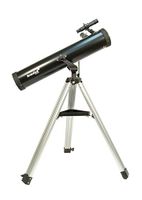
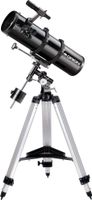
Orion 9851 SpaceProbe 130 EQ Reflector Telescope
The Orion SpaceProbe 130 EQ Reflector with its Explorer II eyepieces serves up bright, clear images of the Moon, the planets, and even deep space objects like star clusters and galaxies. The 25mm eyepiece magnifies the image by 36 times; when I look at the Pleiades or Seven Sisters cluster at 36X the SpaceProbe 130 shows me a bright open cluster with dozens of point-like stars filling the field of view. When I use the 10mm eyepiece (90X magnification) the lunar disk fills the field of view and the rings of Saturn are plainly resolved. And when I use an optional Ultima 2X Barlow with the 10mm eyepiece for 180X magnification I can see the cloud bands of Jupiter and pick out individual stars in bright globular clusters like M13.
The EQ2 equatorial mount included with the Orion SpaceProbe 130 EQ Reflector comes partially assembled, but it shouldn’t take long to set up. The trick to using an equatorial mount is to point the polar axis at Polaris, the North Star. Once the mount is aligned and balanced, the telescope tracks stars and planets at high power with just a turn of one slow motion knob. You can even add an optional motor drive for hands free tracking.
The Orion SpaceProbe 130 EQ Newtonian Reflector Telescope is a simply a great value. The Explorer II eyepieces deliver bright sharp images of the Moon, the planets and the stars, and the EQ2 mount can be motorized for hands free tracking. --Jeff Phillips
Pros:
in next 2 weeks