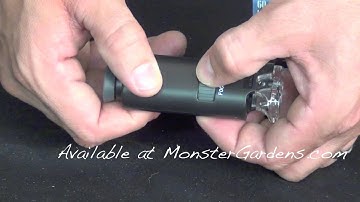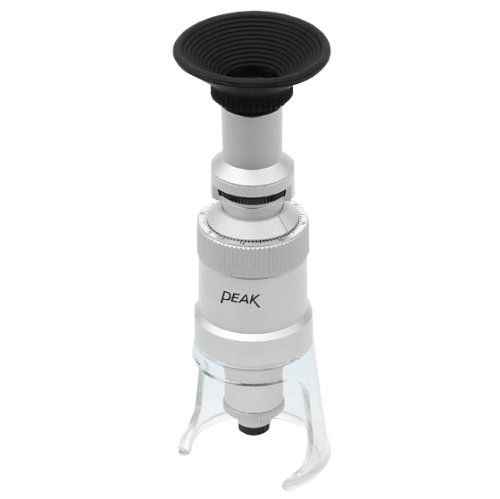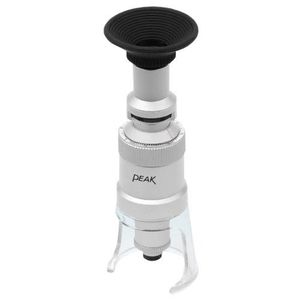
The PEAK TS2008-100 aluminum, handheld, 100x stand microscope has an inch-scale reticle with 0.0005" divisions, a 0.031" measuring range, a 0.033" field of view, and a 0.45" working distance, and is designed for measuring the thickness, height, or depth of specimens. A helicoid twist ring focuses specimens and a diopter-adjustable, soft rubber eyepiece focuses the built-in reticle. The clear acrylic base admits light from all directions. The anodized aluminum construction provides durability for field and classroom applications. The microscope is 4-51/64 x 1-39/64 inches (H x W), and includes a custom storage case. (H is height, the vertical distance from the lowest to highest point; W is width, the horizontal distance from left to right.)
Specifications
| Power | 100x |
| Field of view | 0.033" |
| Measuring range | 0.031" |
| Scale division | 0.0005" |
| Working distance | 0.45" |
| Dimensions* | 4-51/64 x 1-39/64 inches (H x W) |
*H is height, the vertical distance from the lowest to highest point; W is width, the horizontal distance from left to right.
Microscopes are instruments used to enhance the resolution of an object or image. Types include compound, stereo, or digital. Compound microscopes use a compound optical system with an objective lens and an eyepiece. Stereo microscopes show object depth in a three-dimensional image. Digital microscopes are used to display an image on a monitor, rather than looking through a lens. Microscopes can have monocular (one), binocular (two), or trinocular (three) eyepieces, with varying magnification abilities. Magnification ability refers to the size of an image. Resolution, also known as resolvant power, refers to the clarity of th
PEAK TS2008-100 Aluminum Economy Hand Held Stand Microscope with Reticule, 100X Magnification, 0.033" Field View
The PEAK TS2008-100 aluminum, handheld, 100x stand microscope has an inch-scale reticle with 0.0005" divisions, a 0.031" measuring range, a 0.033" field of view, and a 0.45" working distance, and is designed for measuring the thickness, height, or depth of specimens. A helicoid twist ring focuses specimens and a diopter-adjustable, soft rubber eyepiece focuses the built-in reticle. The clear acrylic base admits light from all directions. The anodized aluminum construction provides durability for field and classroom applications. The microscope is 4-51/64 x 1-39/64 inches (H x W), and includes a custom storage case. (H is height, the vertical distance from the lowest to highest point; W is width, the horizontal distance from left to right.)
Specifications
| Power | 100x |
| Field of view | 0.033" |
| Measuring range | 0.031" |
| Scale division | 0.0005" |
| Working distance | 0.45" |
| Dimensions* | 4-51/64 x 1-39/64 inches (H x W) |
*H is height, the vertical distance from the lowest to highest point; W is width, the horizontal distance from left to right.
Microscopes are instruments used to enhance the resolution of an object or image. Types include compound, stereo, or digital. Compound microscopes use a compound optical system with an objective lens and an eyepiece. Stereo microscopes show object depth in a three-dimensional image. Digital microscopes are used to display an image on a monitor, rather than looking through a lens. Microscopes can have monocular (one), binocular (two), or trinocular (three) eyepieces, with varying magnification abilities. Magnification ability refers to the size of an image. Resolution, also known as resolvant power, refers to the clarity of th
in next 2 weeks


By clicking "Accept All", you consent to our use of cookies.