Description
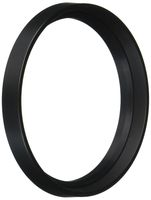
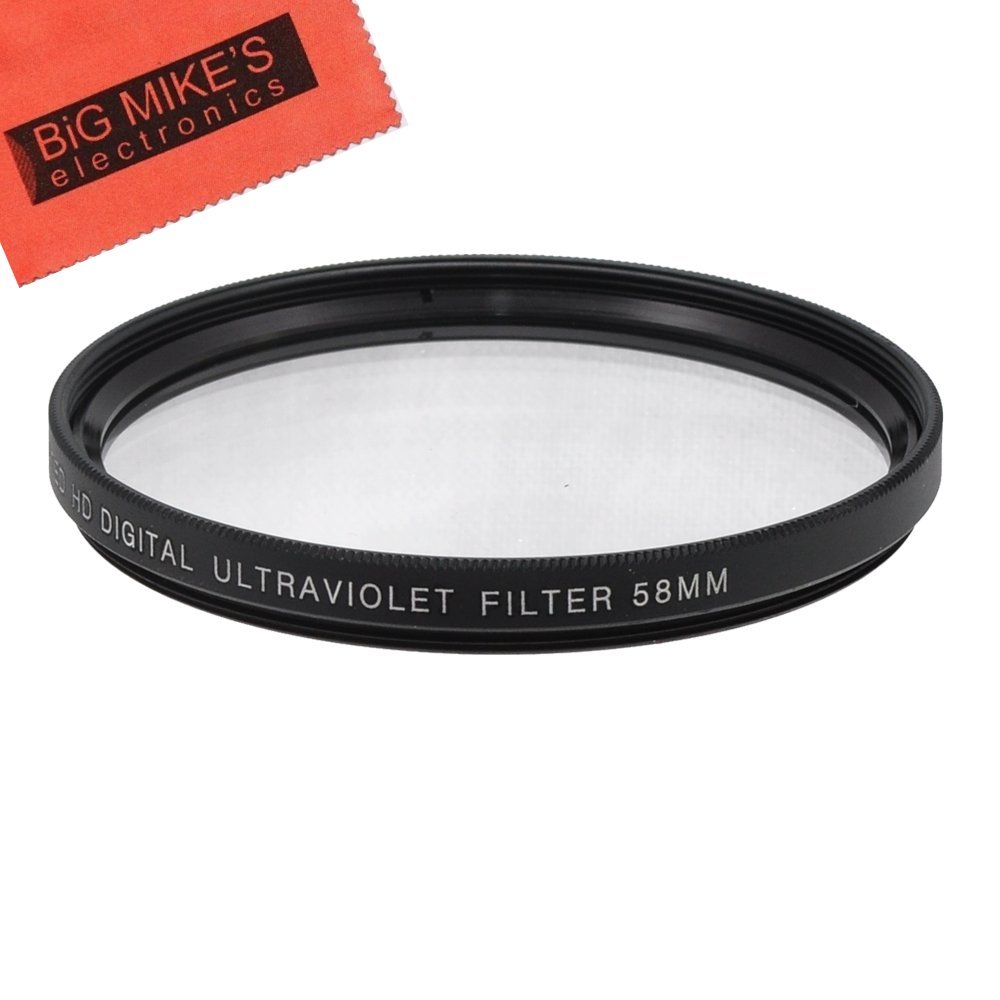
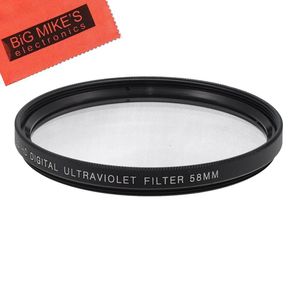
Filter compatible with many other lenses that have a 58mm thread:
What is UV (ultraviolet) light?
The visual spectrum-the light we see with our eyes-consists of the colors red, orange, yellow, green, blue, indigo and violet. Mix them together and you get "white" light. The electromagnetic wavelengths of light are measured in terms of nanometers (nm), with the visual spectrum residing in the 390 to 750nm portion of the electromagnetic bandwidth. Just below the red end of the visual spectrum is infrared (approx 750nm to 1mm) and ultraviolet light resides just above the blue end of the visual spectrum (approx 10nm to 390nm). While we cannot see UV light, it nonetheless impacts the visual quality of the pictures we take.
In the days of film the value of placing a UV filter in front of your lens was never questioned. In addition to dampening the image-robbing effects of atmospheric ultraviolet radiation, UV filters also served to protect the front element of your lens from dust and moisture. They also repelled the inevitable smudges and scratches that over time compromise the effectiveness of the anti-reflective coatings that go into determining how well (or not so well) your pictures turn out. Fast-forward to the modern days of digital imaging and the big argument is: "do we still need UV filters?" The answer is an unqualified "Yes." Despite the fact that digital imaging sensors are nowhere near as sensitive to UV radiation as film, the protective properties of a UV filter on your lens are still quite justified. Regardless of how the image is being recorded, the probability of dust, moisture, smudges and scratches finding their image-compromising way onto your front lens element is equally inevitable and troublesome.
All our filters are carefully formulated to ensure consistent color and accuracy throughout the entire surface of the glass. Why? Consistent color means consistent high quality results.
What is UV (ultraviolet) light?
The visual spectrum-the light we see with our eyes-consists of the colors red, orange, yellow, green, blue, indigo and violet. Mix them together and you get "white" light. The electromagnetic wavelengths of light are measured in terms of nanometers (nm), with the visual spectrum residing in the 390 to 750nm portion of the electromagnetic bandwidth. Just below the red end of the visual spectrum is infrared (approx 750nm to 1mm) and ultraviolet light resides just above the blue end of the visual spectrum (approx 10nm to 390nm). While we cannot see UV light, it nonetheless impacts the visual quality of the pictures we take.
In the days of film the value of placing a UV filter in front of your lens was never questioned. In addition to dampening the image-robbing effects of atmospheric ultraviolet radiation, UV filters also served to protect the front element of your lens from dust and moisture. They also repelled the inevitable smudges and scratches that over time compromise the effectiveness of the anti-reflective coatings that go into determining how well (or not so well) your pictures turn out. Fast-forward to the modern days of digital imaging and the big argument is: "do we still need UV filters?" The answer is an unqualified "Yes." Despite the fact that digital imaging sensors are nowhere near as sensitive to UV radiation as film, the protective properties of a UV filter on your lens are still quite justified. Regardless of how the image is being recorded, the probability of dust, moisture, smudges and scratches finding their image-compromising way onto your front lens element is equally inevitable and troublesome.
All our filters are carefully formulated to ensure consistent color and accuracy throughout the entire surface of the glass. Why? Consistent color means consistent high quality results.
58mm Multi-Coated UV Protective Filter for Canon Rebel T5, T6, T6i, T7i, EOS 80D, EOS 77D Cameras with Canon EF-S 18-55mm f/3.5-5.6 is II, is STM Lens
Current Price
$7.99
Average
$5.99
Min Price
$3.99
Max Price
$7.99
Price dynamics
25%
Description
Filter compatible with many other lenses that have a 58mm thread:
What is UV (ultraviolet) light?
The visual spectrum-the light we see with our eyes-consists of the colors red, orange, yellow, green, blue, indigo and violet. Mix them together and you get "white" light. The electromagnetic wavelengths of light are measured in terms of nanometers (nm), with the visual spectrum residing in the 390 to 750nm portion of the electromagnetic bandwidth. Just below the red end of the visual spectrum is infrared (approx 750nm to 1mm) and ultraviolet light resides just above the blue end of the visual spectrum (approx 10nm to 390nm). While we cannot see UV light, it nonetheless impacts the visual quality of the pictures we take.
In the days of film the value of placing a UV filter in front of your lens was never questioned. In addition to dampening the image-robbing effects of atmospheric ultraviolet radiation, UV filters also served to protect the front element of your lens from dust and moisture. They also repelled the inevitable smudges and scratches that over time compromise the effectiveness of the anti-reflective coatings that go into determining how well (or not so well) your pictures turn out. Fast-forward to the modern days of digital imaging and the big argument is: "do we still need UV filters?" The answer is an unqualified "Yes." Despite the fact that digital imaging sensors are nowhere near as sensitive to UV radiation as film, the protective properties of a UV filter on your lens are still quite justified. Regardless of how the image is being recorded, the probability of dust, moisture, smudges and scratches finding their image-compromising way onto your front lens element is equally inevitable and troublesome.
All our filters are carefully formulated to ensure consistent color and accuracy throughout the entire surface of the glass. Why? Consistent color means consistent high quality results.
What is UV (ultraviolet) light?
The visual spectrum-the light we see with our eyes-consists of the colors red, orange, yellow, green, blue, indigo and violet. Mix them together and you get "white" light. The electromagnetic wavelengths of light are measured in terms of nanometers (nm), with the visual spectrum residing in the 390 to 750nm portion of the electromagnetic bandwidth. Just below the red end of the visual spectrum is infrared (approx 750nm to 1mm) and ultraviolet light resides just above the blue end of the visual spectrum (approx 10nm to 390nm). While we cannot see UV light, it nonetheless impacts the visual quality of the pictures we take.
In the days of film the value of placing a UV filter in front of your lens was never questioned. In addition to dampening the image-robbing effects of atmospheric ultraviolet radiation, UV filters also served to protect the front element of your lens from dust and moisture. They also repelled the inevitable smudges and scratches that over time compromise the effectiveness of the anti-reflective coatings that go into determining how well (or not so well) your pictures turn out. Fast-forward to the modern days of digital imaging and the big argument is: "do we still need UV filters?" The answer is an unqualified "Yes." Despite the fact that digital imaging sensors are nowhere near as sensitive to UV radiation as film, the protective properties of a UV filter on your lens are still quite justified. Regardless of how the image is being recorded, the probability of dust, moisture, smudges and scratches finding their image-compromising way onto your front lens element is equally inevitable and troublesome.
All our filters are carefully formulated to ensure consistent color and accuracy throughout the entire surface of the glass. Why? Consistent color means consistent high quality results.
Price will be lower
in next 2 weeks
in next 2 weeks
According to the data, price will be lower in next two weeks, so not waste your money and track better price!
Product review & video
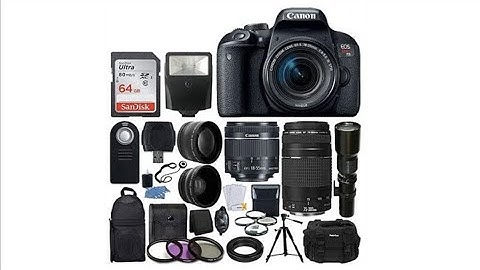
hi friends I just got an order from Amazon and this is my new Canon p7 ID SLR camera I'm like so very excited to open this package come on let's see what we have in the package oh my god I have another box inside this is packed so securely open that the packages all the containers now we are going to see one by one this is a high-speed card reader this is compatible for Mac also see the second one this is a digital filter set this is a 3 piece filter set actually so it's it's a UV filter circular polarizer CPL filter and fluorescent filter then we have a universal wireless remote control so this is to use better Canon camera oh this is our memory card this is a 64 GB memory card the next one is a three PC Universal screen protector kit the instructions are provided at the back of the package so you can read it the next one is a diamond so this is a lens mount for SLR cameras we have a v

Similar products