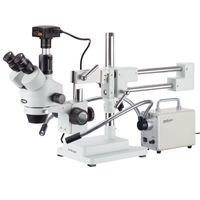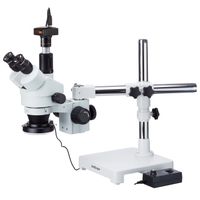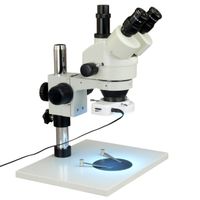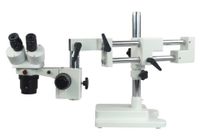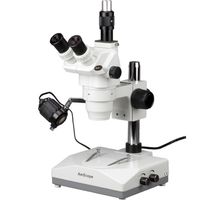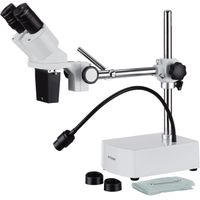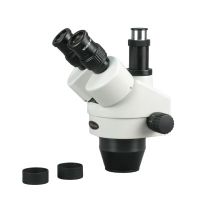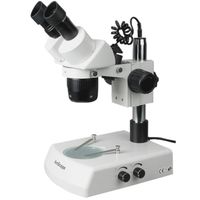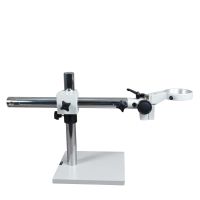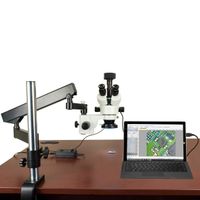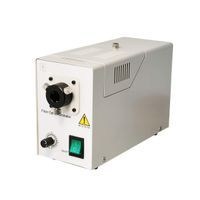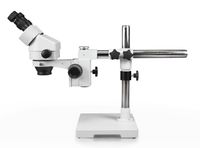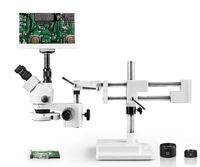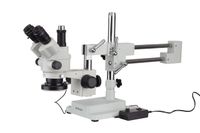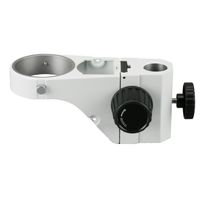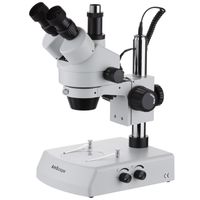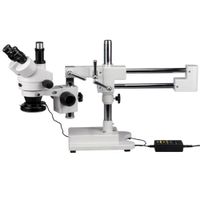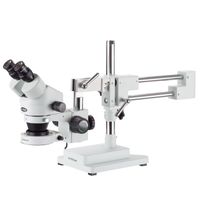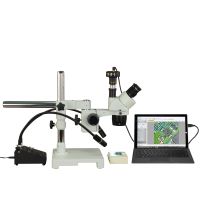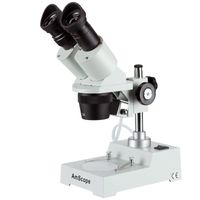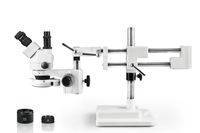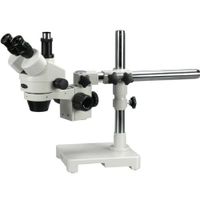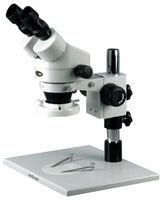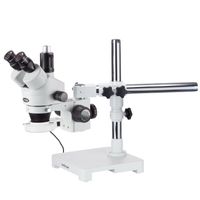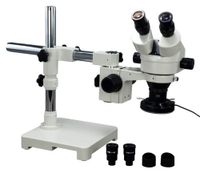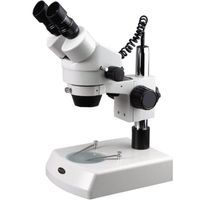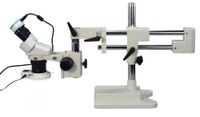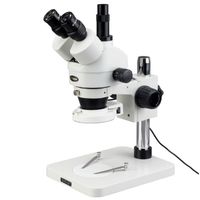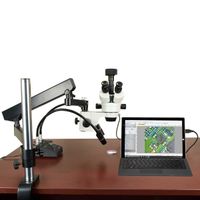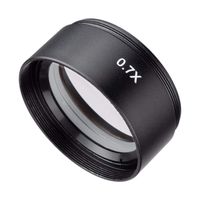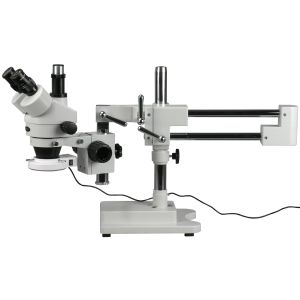
The AmScope SM-4TZ-56S professional trinocular stereo zoom microscope has a pair of 10x super-widefield high-eyepoint eyepieces, a 0.7x-4.5x zoom objective, two Barlow lenses, and a double-arm boom stand. The microscope has an overall magnification range of 3.5x-90x. The trinocular viewing head has an interpupillary range of 55 to 75mm, a 45-degree inclination to reduce eye and neck strain, and 360-degree rotation to enable sharing. The vertical trinocular port can be used as a C-Mount or 23mm photo port (camera sold separately). The WH10x20mm super-widefield high-eyepoint eyepieces combine with the 0.7x-4.5x zoom objective to provide continuous zoom magnification and a longer working distance for inspecting large-scale specimens that require handling or repair. The microscope comes with 0.5x and 2.0x Barlow lenses that can be added to the objective to increase the magnification range. A Barlow lens with a magnification of less than 1.0 reduces magnification and increases the working distance, while a Barlow lens with a magnification greater than 1.0 increases the magnification and reduces the working distance. High-eyepoint eyepieces ease viewing for users who wear glasses, and dioptric adjustment accommodates individual eye-strength differences. A stereo microscope, sometimes called an inspection or dissection microscope, has low magnification and a long working distance that enables users to manipulate the object being inspected.
The removable 56-bulb LED ring light provides bright, cool light for working with temperature-sensitive or live specimens. The ring light provides shadow-free illumination, and a rheostat controls the amount of light emanating from the lamp. Power and adjustment controls are located on the light head. The light uses a 110V-240V variable power supply. The microscope has a double-arm boom stand that enables users to position the microscope head on all three axes (X, Y, and Z). Bilateral focus eases use for left
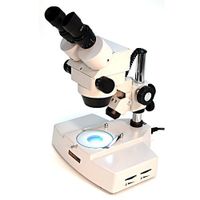
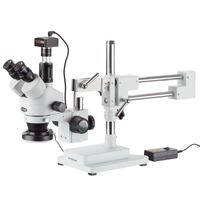
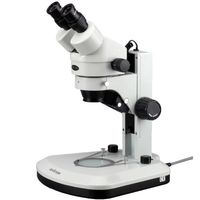
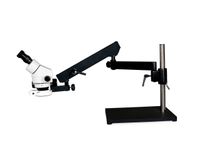
AmScope SM-4TZ-56S Professional Trinocular Stereo Zoom Microscope, WH10x Eyepieces, 3.5X-90X Magnification, 0.7X-4.5X Zoom Objective, 56-Bulb LED Ring Light, Double-Arm Boom Stand, 110V-120V, 110V-240V, Includes 0.5X and 2.0X Barlow Lens
The AmScope SM-4TZ-56S professional trinocular stereo zoom microscope has a pair of 10x super-widefield high-eyepoint eyepieces, a 0.7x-4.5x zoom objective, two Barlow lenses, and a double-arm boom stand. The microscope has an overall magnification range of 3.5x-90x. The trinocular viewing head has an interpupillary range of 55 to 75mm, a 45-degree inclination to reduce eye and neck strain, and 360-degree rotation to enable sharing. The vertical trinocular port can be used as a C-Mount or 23mm photo port (camera sold separately). The WH10x20mm super-widefield high-eyepoint eyepieces combine with the 0.7x-4.5x zoom objective to provide continuous zoom magnification and a longer working distance for inspecting large-scale specimens that require handling or repair. The microscope comes with 0.5x and 2.0x Barlow lenses that can be added to the objective to increase the magnification range. A Barlow lens with a magnification of less than 1.0 reduces magnification and increases the working distance, while a Barlow lens with a magnification greater than 1.0 increases the magnification and reduces the working distance. High-eyepoint eyepieces ease viewing for users who wear glasses, and dioptric adjustment accommodates individual eye-strength differences. A stereo microscope, sometimes called an inspection or dissection microscope, has low magnification and a long working distance that enables users to manipulate the object being inspected.
The removable 56-bulb LED ring light provides bright, cool light for working with temperature-sensitive or live specimens. The ring light provides shadow-free illumination, and a rheostat controls the amount of light emanating from the lamp. Power and adjustment controls are located on the light head. The light uses a 110V-240V variable power supply. The microscope has a double-arm boom stand that enables users to position the microscope head on all three axes (X, Y, and Z). Bilateral focus eases use for left
in next 2 weeks
By clicking "Accept All", you consent to our use of cookies.