- HomeElectronicsAccessories & SuppliesAudio & Video AccessoriesCables & InterconnectsAudio CablesFiber Optic Cables
Description
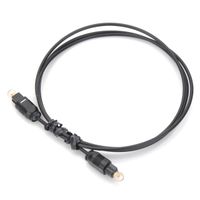
For these many reasons, AudioQuest has refined and renewed our line of serious high-performance OptiLink cables. All models and all lengths are now available Toslink- Toslink and Toslink - 3.5mm Mini Optical. When the question is "how can a fiber-optic cable change the sound?" ... the answer is easier to explain than for almost any other type of cable. If the light source were a coherent laser, firing into a vacuum, all the light would stay straight, arriving at its destination at the same time. Even if the LED light source in a Toslink system were coherent, the light entering a fiber-optic cable is scattered and dispersed by imperfections and impurities in the fiber. This can be measured as a loss of amplitude ... but amplitude is not the problem, a 50% true loss would have no effect on sound quality. The problem is that the dispersed light does get through the cable, but only after it has taken a longer path, like a pool ball bouncing off the side-rails, causing it to arrive later. This delayed part of the signal prevents the computer charged with decoding this information from being able to decode properly, or even at all. The inability to decode shows first at higher frequencies (not audio frequencies, this is a mono stream of digital audio information), so reduced bandwidth is a measurable signature of light being dispersed by a fiber. The punch line: The less dispersion in the fiber, the less distortion in the final analog audio signal presented to our ears.
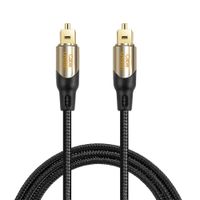
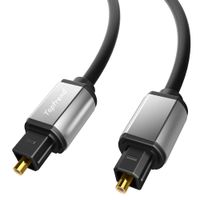
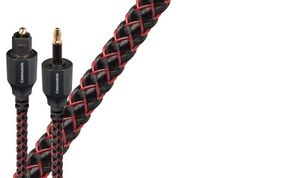
AudioQuest Cinnamon OptiLink 3m (10 ft.) Full to 3.5mm Optical Audio Cable
Current Price
$122.95
Average
$102.17
Min Price
$70.69
Max Price
$122.95
Price dynamics
17%
Description
For these many reasons, AudioQuest has refined and renewed our line of serious high-performance OptiLink cables. All models and all lengths are now available Toslink- Toslink and Toslink - 3.5mm Mini Optical. When the question is "how can a fiber-optic cable change the sound?" ... the answer is easier to explain than for almost any other type of cable. If the light source were a coherent laser, firing into a vacuum, all the light would stay straight, arriving at its destination at the same time. Even if the LED light source in a Toslink system were coherent, the light entering a fiber-optic cable is scattered and dispersed by imperfections and impurities in the fiber. This can be measured as a loss of amplitude ... but amplitude is not the problem, a 50% true loss would have no effect on sound quality. The problem is that the dispersed light does get through the cable, but only after it has taken a longer path, like a pool ball bouncing off the side-rails, causing it to arrive later. This delayed part of the signal prevents the computer charged with decoding this information from being able to decode properly, or even at all. The inability to decode shows first at higher frequencies (not audio frequencies, this is a mono stream of digital audio information), so reduced bandwidth is a measurable signature of light being dispersed by a fiber. The punch line: The less dispersion in the fiber, the less distortion in the final analog audio signal presented to our ears.
Price will be lower
in next 2 weeks
in next 2 weeks
According to the data, price will be lower in next two weeks, so not waste your money and track better price!
Product review & video
- Of all the technologies
that we have right now that suggest we really
are living in the future, perhaps nothing sounds more
futuristic than the fact that we can transmit
data with laser light. Indeed, many of the
highest capacity cables that form the backbone of the
internet use fiber optics. And fiber to the home connections that deliver very high speeds, have become more popular in recent years. But did you know that one
optical technology that used to be pretty common place in home audio, is now getting replaced by
good old fashioned copper? I'm not talking about CDs, which you can learn more about up here. I'm actually referring to the Toshiba Link or Toslink connector. If you're not sure what that is, there's actually a good
chance you have one, on the back of your desktop PC. It's a square-ish looking connector that's lit up with red light. They were also extremely common, not s