Description
All Ship in US Warehouse
How do bedwetting alarms work?
Bedwetting alarms work on the principle of Conditioned Learning. This principle was discovered by Pavlov, a Russian psychologist in the early 1900s. He found that if a powerful stimulus is associated with a neutral one then after a time the neutral one acquires the same strength as the powerful one.
In his work with dogs Pavlov found that putting food in a dog's mouth was a powerful stimulus triggering the production of saliva. He then experimented with ringing a bell each time he gave the dog some food and after a time he found that simply ringing a bell would result in the dog producing saliva. People are also affected by this kind of learning. Whenever a powerful and neutral stimulus occur together, a link is made.
In the case of bed wetters the sensation of a full bladder should trigger awakening but it doesn't. However, the sound of a loud noise can trigger waking and cause an immediate contraction of the external sphincter muscle which stops the flow of urine from the bladder. The solution is to pair up the feeling of a full bladder with a loud noise so that, in time, the sensation of a full bladder will do the waking just like a loud noise.
Bedwetting is a problem for many school age children and their families.
Bedwetting is one of the most common childhood complaints.
At four years of age nearly one in three children wets the bed.
16.6% of five year olds wet the bed.
About 10% of seven year olds wet the bed.
Bedwetting is more common in boys than girls with around double the number of boys wetting the bed compared to girls.
Bedwetting can be inherited. If one parent suffered nocturnal enuresis as a child there is approx a 43% chance of their child wetting the bed.
How do bedwetting alarms work?
Bedwetting alarms work on the principle of Conditioned Learning. This principle was discovered by Pavlov, a Russian psychologist in the early 1900s. He found that if a powerful stimulus is associated with a neutral one then after a time the neutral one acquires the same strength as the powerful one.
In his work with dogs Pavlov found that putting food in a dog's mouth was a powerful stimulus triggering the production of saliva. He then experimented with ringing a bell each time he gave the dog some food and after a time he found that simply ringing a bell would result in the dog producing saliva. People are also affected by this kind of learning. Whenever a powerful and neutral stimulus occur together, a link is made.
In the case of bed wetters the sensation of a full bladder should trigger awakening but it doesn't. However, the sound of a loud noise can trigger waking and cause an immediate contraction of the external sphincter muscle which stops the flow of urine from the bladder. The solution is to pair up the feeling of a full bladder with a loud noise so that, in time, the sensation of a full bladder will do the waking just like a loud noise.
Bedwetting is a problem for many school age children and their families.
Bedwetting is one of the most common childhood complaints.
At four years of age nearly one in three children wets the bed.
16.6% of five year olds wet the bed.
About 10% of seven year olds wet the bed.
Bedwetting is more common in boys than girls with around double the number of boys wetting the bed compared to girls.
Bedwetting can be inherited. If one parent suffered nocturnal enuresis as a child there is approx a 43% chance of their child wetting the bed.
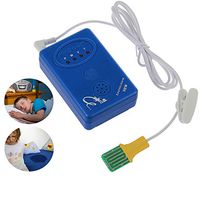
Bedwetting Alarm for Boys Girls Kids Training Children and Kids to Stop Night Time Moisture Easy Solutions Control Nocturnal Enuresis Alarm System
Current Price
$25.99
Average
$23.75
Min Price
$21.99
Max Price
$25.99
Price dynamics
9%
Description
All Ship in US Warehouse
How do bedwetting alarms work?
Bedwetting alarms work on the principle of Conditioned Learning. This principle was discovered by Pavlov, a Russian psychologist in the early 1900s. He found that if a powerful stimulus is associated with a neutral one then after a time the neutral one acquires the same strength as the powerful one.
In his work with dogs Pavlov found that putting food in a dog's mouth was a powerful stimulus triggering the production of saliva. He then experimented with ringing a bell each time he gave the dog some food and after a time he found that simply ringing a bell would result in the dog producing saliva. People are also affected by this kind of learning. Whenever a powerful and neutral stimulus occur together, a link is made.
In the case of bed wetters the sensation of a full bladder should trigger awakening but it doesn't. However, the sound of a loud noise can trigger waking and cause an immediate contraction of the external sphincter muscle which stops the flow of urine from the bladder. The solution is to pair up the feeling of a full bladder with a loud noise so that, in time, the sensation of a full bladder will do the waking just like a loud noise.
Bedwetting is a problem for many school age children and their families.
Bedwetting is one of the most common childhood complaints.
At four years of age nearly one in three children wets the bed.
16.6% of five year olds wet the bed.
About 10% of seven year olds wet the bed.
Bedwetting is more common in boys than girls with around double the number of boys wetting the bed compared to girls.
Bedwetting can be inherited. If one parent suffered nocturnal enuresis as a child there is approx a 43% chance of their child wetting the bed.
How do bedwetting alarms work?
Bedwetting alarms work on the principle of Conditioned Learning. This principle was discovered by Pavlov, a Russian psychologist in the early 1900s. He found that if a powerful stimulus is associated with a neutral one then after a time the neutral one acquires the same strength as the powerful one.
In his work with dogs Pavlov found that putting food in a dog's mouth was a powerful stimulus triggering the production of saliva. He then experimented with ringing a bell each time he gave the dog some food and after a time he found that simply ringing a bell would result in the dog producing saliva. People are also affected by this kind of learning. Whenever a powerful and neutral stimulus occur together, a link is made.
In the case of bed wetters the sensation of a full bladder should trigger awakening but it doesn't. However, the sound of a loud noise can trigger waking and cause an immediate contraction of the external sphincter muscle which stops the flow of urine from the bladder. The solution is to pair up the feeling of a full bladder with a loud noise so that, in time, the sensation of a full bladder will do the waking just like a loud noise.
Bedwetting is a problem for many school age children and their families.
Bedwetting is one of the most common childhood complaints.
At four years of age nearly one in three children wets the bed.
16.6% of five year olds wet the bed.
About 10% of seven year olds wet the bed.
Bedwetting is more common in boys than girls with around double the number of boys wetting the bed compared to girls.
Bedwetting can be inherited. If one parent suffered nocturnal enuresis as a child there is approx a 43% chance of their child wetting the bed.
Price will be lower
in next 2 weeks
in next 2 weeks
According to the data, price will be lower in next two weeks, so not waste your money and track better price!

Similar products