Description
This book has been used for 30 years, updated periodically as needed. More than 20,000 students have successfully learned ocean navigation from these materials and gone on to cross oceans or circumnavigate the globe.
This book covers how to find position at sea from timed sextant sights of the sun, moon, stars, and planets plus other routine and special procedures of safe, efficient offshore navigation. No previous navigation experience is required. The only math involved is arithmetic (adding and subtracting angles and times).
This is a practical, how-to-do-it book, which also includes clear explanations of how it works and how to do it well. Plus this book includes other crucial factors of ocean navigation besides just finding out where you are from the stars, such as logbook procedures, dead reckoning, error analysis, route planning, and more. At the end of this book, you will be ready for ocean navigation.
The book includes: text, practice problems, tables selections, detailed glossary, and full solutions. Printable work forms, plotting sheets, and other resources are available at no charge from starpath.com/celnavbook.
Our Fit-Slope Method presented in this textbook is cited in the latest (2017) edition of Bowditch:
"The common method of averaging sights is the Fit-Slope Method, e.g. Burch, D. 2015, Celestial Navigation, Second Edition (Seattle, Starpath Publications) pp. 176-177." --Bowditch, American Practical Navigator, NGA Pub 9. Section 1805.
Preface to the Second Edition.
We are pleased to say that after ten more years of using this text we do not find reason to change the basic approach and methods of the teaching. We still use most of the same examples, which are now quite old, but that is the beauty of celestial navigation. It has not changed, so we do not benefit in any way from making all new examples, which would bring with them more chance of error in a book of many numbers.
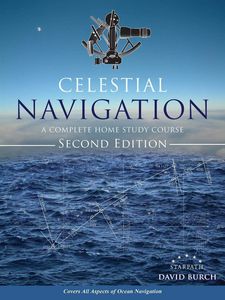
This book covers how to find position at sea from timed sextant sights of the sun, moon, stars, and planets plus other routine and special procedures of safe, efficient offshore navigation. No previous navigation experience is required. The only math involved is arithmetic (adding and subtracting angles and times).
This is a practical, how-to-do-it book, which also includes clear explanations of how it works and how to do it well. Plus this book includes other crucial factors of ocean navigation besides just finding out where you are from the stars, such as logbook procedures, dead reckoning, error analysis, route planning, and more. At the end of this book, you will be ready for ocean navigation.
The book includes: text, practice problems, tables selections, detailed glossary, and full solutions. Printable work forms, plotting sheets, and other resources are available at no charge from starpath.com/celnavbook.
Our Fit-Slope Method presented in this textbook is cited in the latest (2017) edition of Bowditch:
"The common method of averaging sights is the Fit-Slope Method, e.g. Burch, D. 2015, Celestial Navigation, Second Edition (Seattle, Starpath Publications) pp. 176-177." --Bowditch, American Practical Navigator, NGA Pub 9. Section 1805.
Preface to the Second Edition.
We are pleased to say that after ten more years of using this text we do not find reason to change the basic approach and methods of the teaching. We still use most of the same examples, which are now quite old, but that is the beauty of celestial navigation. It has not changed, so we do not benefit in any way from making all new examples, which would bring with them more chance of error in a book of many numbers.
Celestial Navigation: A Complete Home Study Course, Second Edition
Price is below average
Current Price
$29.99
Average
$32.81
Min Price
$29.38
Max Price
$39
Price dynamics
9%
Description
This book has been used for 30 years, updated periodically as needed. More than 20,000 students have successfully learned ocean navigation from these materials and gone on to cross oceans or circumnavigate the globe.
This book covers how to find position at sea from timed sextant sights of the sun, moon, stars, and planets plus other routine and special procedures of safe, efficient offshore navigation. No previous navigation experience is required. The only math involved is arithmetic (adding and subtracting angles and times).
This is a practical, how-to-do-it book, which also includes clear explanations of how it works and how to do it well. Plus this book includes other crucial factors of ocean navigation besides just finding out where you are from the stars, such as logbook procedures, dead reckoning, error analysis, route planning, and more. At the end of this book, you will be ready for ocean navigation.
The book includes: text, practice problems, tables selections, detailed glossary, and full solutions. Printable work forms, plotting sheets, and other resources are available at no charge from starpath.com/celnavbook.
Our Fit-Slope Method presented in this textbook is cited in the latest (2017) edition of Bowditch:
"The common method of averaging sights is the Fit-Slope Method, e.g. Burch, D. 2015, Celestial Navigation, Second Edition (Seattle, Starpath Publications) pp. 176-177." --Bowditch, American Practical Navigator, NGA Pub 9. Section 1805.
Preface to the Second Edition.
We are pleased to say that after ten more years of using this text we do not find reason to change the basic approach and methods of the teaching. We still use most of the same examples, which are now quite old, but that is the beauty of celestial navigation. It has not changed, so we do not benefit in any way from making all new examples, which would bring with them more chance of error in a book of many numbers.

This book covers how to find position at sea from timed sextant sights of the sun, moon, stars, and planets plus other routine and special procedures of safe, efficient offshore navigation. No previous navigation experience is required. The only math involved is arithmetic (adding and subtracting angles and times).
This is a practical, how-to-do-it book, which also includes clear explanations of how it works and how to do it well. Plus this book includes other crucial factors of ocean navigation besides just finding out where you are from the stars, such as logbook procedures, dead reckoning, error analysis, route planning, and more. At the end of this book, you will be ready for ocean navigation.
The book includes: text, practice problems, tables selections, detailed glossary, and full solutions. Printable work forms, plotting sheets, and other resources are available at no charge from starpath.com/celnavbook.
Our Fit-Slope Method presented in this textbook is cited in the latest (2017) edition of Bowditch:
"The common method of averaging sights is the Fit-Slope Method, e.g. Burch, D. 2015, Celestial Navigation, Second Edition (Seattle, Starpath Publications) pp. 176-177." --Bowditch, American Practical Navigator, NGA Pub 9. Section 1805.
Preface to the Second Edition.
We are pleased to say that after ten more years of using this text we do not find reason to change the basic approach and methods of the teaching. We still use most of the same examples, which are now quite old, but that is the beauty of celestial navigation. It has not changed, so we do not benefit in any way from making all new examples, which would bring with them more chance of error in a book of many numbers.
Price will be lower
in next 2 weeks
in next 2 weeks
According to the data, price will be lower in next two weeks, so not waste your money and track better price!
Similar products