Description
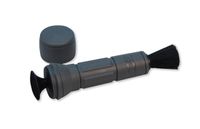
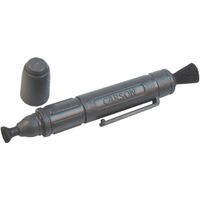
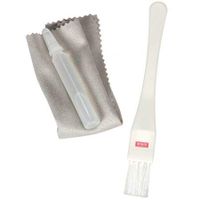
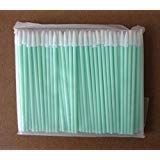
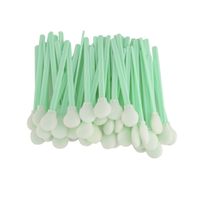
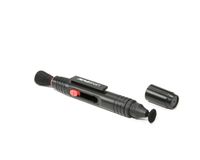
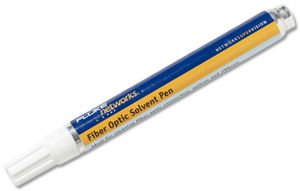
Contaminated end-faces are the #1 cause of fiber link failure. Dirt and contaminants cause insertion loss and back-reflection that inhibit the light transmission and causes havoc with transceivers. Since dirt can migrate from one end-face to another upon mating, both sides of any connection must be inspected. Mating contaminated connectors can cause permanent damage as microscopic debris can be crushed between end-faces during physical contact. For years, isopropyl alcohol (IPA) was used to clean fiber end-faces but now there are customized solvents that are far superior, such as Fluke Networks Fiber Optic Solvent Pen. Most importantly, this specialized solvent is more effective than IPA at dissolving all contaminants, especially non-ionic compounds such as buffer gel and pulling lube. You will get a better clean every time and remove more contamination. The Fluke Networks Solvent Pen has a lower surface tension that allows it to envelop particles and debris, thus effectively lifting them from the surface of the end-face as they are carried away by a wipe or swab. Many smaller particles carry a charge that bonds them to the ferrule or end-face. The solvent is oxygenated to neutralize this charge so the charged particle can be wiped away and additional particles are not attracted onto the end-face. When cleaning end-faces inside ports or equipment, the evaporation rate of solvents become significant as it is harder to guarantee removal of all solvent. Fluke Networks customized solvent has an evaporation rate tailored to stay long enough to work yet still disappear before mating. It evaporates much faster than IPA. Last, IPA is highly hygroscopic and therefore draws water vapor that can then dry on the end-face and leave a residue, which can appear as a “halo.”
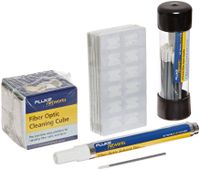
Fluke Networks NFC-SOLVENTPEN Fiber Optic Cleaning Solvent Pen
Current Price
$18.99
Average
$15.97
Min Price
$10
Max Price
$26.51
Price dynamics
16%
Description
Contaminated end-faces are the #1 cause of fiber link failure. Dirt and contaminants cause insertion loss and back-reflection that inhibit the light transmission and causes havoc with transceivers. Since dirt can migrate from one end-face to another upon mating, both sides of any connection must be inspected. Mating contaminated connectors can cause permanent damage as microscopic debris can be crushed between end-faces during physical contact. For years, isopropyl alcohol (IPA) was used to clean fiber end-faces but now there are customized solvents that are far superior, such as Fluke Networks Fiber Optic Solvent Pen. Most importantly, this specialized solvent is more effective than IPA at dissolving all contaminants, especially non-ionic compounds such as buffer gel and pulling lube. You will get a better clean every time and remove more contamination. The Fluke Networks Solvent Pen has a lower surface tension that allows it to envelop particles and debris, thus effectively lifting them from the surface of the end-face as they are carried away by a wipe or swab. Many smaller particles carry a charge that bonds them to the ferrule or end-face. The solvent is oxygenated to neutralize this charge so the charged particle can be wiped away and additional particles are not attracted onto the end-face. When cleaning end-faces inside ports or equipment, the evaporation rate of solvents become significant as it is harder to guarantee removal of all solvent. Fluke Networks customized solvent has an evaporation rate tailored to stay long enough to work yet still disappear before mating. It evaporates much faster than IPA. Last, IPA is highly hygroscopic and therefore draws water vapor that can then dry on the end-face and leave a residue, which can appear as a “halo.”
Price will be lower
in next 2 weeks
in next 2 weeks
According to the data, price will be lower in next two weeks, so not waste your money and track better price!
Product review & video
contamination it's the number one cause of optical fiber failure in data centers and it's also the easiest and most inexpensive to prevent this shouldn't be a surprise given that the diameter of an optical fiber core is smaller than that of a human hair microscopic contaminants can effectively block light from being transmitted through a link the most effective method of cleaning fiber and faces reports is using a specialized solvent with what ifs or swabs in fact a recent study published by a major cable manufacturer states that you can actually gain anywhere between 0.14 to 1.3 9 DB from cleaning it alone to find out whether a fiber and face report is dirty you'll need a microscope using one of fluke networks video or optical microscopes you can clearly and easily examine n face or pork for any contamination there are lots of contaminant sources but the most common of these are airbor

Similar products