Description
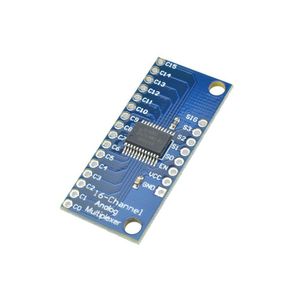
This is a breakout board for the very handy 16-Channel Analog/Digital Multiplexer/Demultiplexer CD74HC4067.
This chip is like a rotary switch - it internally routes the common pin (COM in the schematic, SIG on the board)to one of 16 channel pins (CHANxx).
It works with both digital and analog signals (the voltage can't be higher than VCC), and the connections function in either direction.
To control it, connect 4 digital outputs to the chip's address select pins (S0-S3), and send it the binary address of the channel you want (see the datasheet for details). This allows you to connect up to 16 sensors to your system using only 5 pins!
Since the mux/demux also works with digital signals, you can use it to pipe TTL-level serial data to or from multiple devices.
For example, you could use it to connect the TX pins of 16 devices to one RX pin on your microcontroller.
You can then select any one of those 16 devices to listen to.
If you want two-way communications, you can add a second board to route your microcontroller's TX line to 16 device's RX lines.
By using multiple boards, you can create similar arrangements for I2C, SPI, etc.
The internal switches are bidirectional, support voltages between ground and VCC, have low "on" resistance and low "off" leakage, and to prevent crosstalk, perform "break-before-make" switching.
The board also breaks out the chip's "enable" pin, which when driven high, will completely disconnect the common pin (all switches "off").
Features:
1.2V to 6V operation 2."On" resistance: 70 Ohms @ 4.5V 3.6ns break-before-make @ 4.5V 4.Wide operating temperature range: -55C to 125C
This chip is like a rotary switch - it internally routes the common pin (COM in the schematic, SIG on the board)to one of 16 channel pins (CHANxx).
It works with both digital and analog signals (the voltage can't be higher than VCC), and the connections function in either direction.
To control it, connect 4 digital outputs to the chip's address select pins (S0-S3), and send it the binary address of the channel you want (see the datasheet for details). This allows you to connect up to 16 sensors to your system using only 5 pins!
Since the mux/demux also works with digital signals, you can use it to pipe TTL-level serial data to or from multiple devices.
For example, you could use it to connect the TX pins of 16 devices to one RX pin on your microcontroller.
You can then select any one of those 16 devices to listen to.
If you want two-way communications, you can add a second board to route your microcontroller's TX line to 16 device's RX lines.
By using multiple boards, you can create similar arrangements for I2C, SPI, etc.
The internal switches are bidirectional, support voltages between ground and VCC, have low "on" resistance and low "off" leakage, and to prevent crosstalk, perform "break-before-make" switching.
The board also breaks out the chip's "enable" pin, which when driven high, will completely disconnect the common pin (all switches "off").
Features:
1.2V to 6V operation 2."On" resistance: 70 Ohms @ 4.5V 3.6ns break-before-make @ 4.5V 4.Wide operating temperature range: -55C to 125C
Aideepen CD74HC4067 16-Channel Analog Digital Multiplexer Breakout Board Module for Arduino
Current Price
$5.11
Average
$4.93
Min Price
$4.5
Max Price
$5.37
Price dynamics
4%
Description
This is a breakout board for the very handy 16-Channel Analog/Digital Multiplexer/Demultiplexer CD74HC4067.
This chip is like a rotary switch - it internally routes the common pin (COM in the schematic, SIG on the board)to one of 16 channel pins (CHANxx).
It works with both digital and analog signals (the voltage can't be higher than VCC), and the connections function in either direction.
To control it, connect 4 digital outputs to the chip's address select pins (S0-S3), and send it the binary address of the channel you want (see the datasheet for details). This allows you to connect up to 16 sensors to your system using only 5 pins!
Since the mux/demux also works with digital signals, you can use it to pipe TTL-level serial data to or from multiple devices.
For example, you could use it to connect the TX pins of 16 devices to one RX pin on your microcontroller.
You can then select any one of those 16 devices to listen to.
If you want two-way communications, you can add a second board to route your microcontroller's TX line to 16 device's RX lines.
By using multiple boards, you can create similar arrangements for I2C, SPI, etc.
The internal switches are bidirectional, support voltages between ground and VCC, have low "on" resistance and low "off" leakage, and to prevent crosstalk, perform "break-before-make" switching.
The board also breaks out the chip's "enable" pin, which when driven high, will completely disconnect the common pin (all switches "off").
Features:
1.2V to 6V operation 2."On" resistance: 70 Ohms @ 4.5V 3.6ns break-before-make @ 4.5V 4.Wide operating temperature range: -55C to 125C
This chip is like a rotary switch - it internally routes the common pin (COM in the schematic, SIG on the board)to one of 16 channel pins (CHANxx).
It works with both digital and analog signals (the voltage can't be higher than VCC), and the connections function in either direction.
To control it, connect 4 digital outputs to the chip's address select pins (S0-S3), and send it the binary address of the channel you want (see the datasheet for details). This allows you to connect up to 16 sensors to your system using only 5 pins!
Since the mux/demux also works with digital signals, you can use it to pipe TTL-level serial data to or from multiple devices.
For example, you could use it to connect the TX pins of 16 devices to one RX pin on your microcontroller.
You can then select any one of those 16 devices to listen to.
If you want two-way communications, you can add a second board to route your microcontroller's TX line to 16 device's RX lines.
By using multiple boards, you can create similar arrangements for I2C, SPI, etc.
The internal switches are bidirectional, support voltages between ground and VCC, have low "on" resistance and low "off" leakage, and to prevent crosstalk, perform "break-before-make" switching.
The board also breaks out the chip's "enable" pin, which when driven high, will completely disconnect the common pin (all switches "off").
Features:
1.2V to 6V operation 2."On" resistance: 70 Ohms @ 4.5V 3.6ns break-before-make @ 4.5V 4.Wide operating temperature range: -55C to 125C
Price will be lower
in next 2 weeks
in next 2 weeks
According to the data, price will be lower in next two weeks, so not waste your money and track better price!
Product review & video
this video presents the interfacing of a 16 channel multiplexer with arduino pro mini the multiplexer is based on ic744067 that passes a signal to one of the 16 outputs based on a 4-bit select value the 16-channel analog multiplexer module is shown here which is based on the ic-4067 as a multiplexer a signal at one of the channel inputs will be passed into the signal pin here or signal line based on the 4-bit value on the select lines from s0 to s3 as a demultiplexer a signal at input signal here will be passed to one of the 16 channel outputs again based on the binary 4-bit value on selector lines s0 to s3 in this video the module will be used as a demultiplexer where the lines s0 s1 s2 s3 and signal will be connected to digital output pins of the arduino and a digital signal will be applied to the signal pin to be transferred to one of the selected output channels of the module lookin



Similar products