For starters, Nintendo has quite clearly made this a game-only machine. It doesn't try to play your CD collection, run your movies, read your e-mail, or store your MP3 files. The company has concentrated its efforts on games. All the prelaunch titles we've seen play smoothly, with bright, fast graphics and great sound. Nintendo says its engineers have removed traditional bottlenecks that have, in the past, slowed down processing. New components designed by IBM and MoSys, as well as a large-capacity secondary memory cache, keep instructions moving through the system's microprocessor (MPU) at peak levels. In English: the GameCube is optimized to push speed up while pushing costs down; hence its position at the lower end of the price spectrum.
The GameCube is the first Nintendo video game system to use a disc-based medium rather than cartridges for its games. Moving the software to disc media generally means lower development costs for the publishers, which, in turn, trickles down to the consumer not only in price, but also in availability and quality, as it's then easier to try out untested game ideas (Pikmin, anyone?). While most other systems likewise have their games stored on discs, the GameCube's 3-inch format is smaller than everyone else's, and is so designed to fit in a shirt pocket as much as to deter would-be software pirates.
Of course, the main advantage of the GameCube is that it's the home field of one of the world's premier game designers: Nintendo. While powerhouses Electronic Arts and Sega make games for all systems (including this one), you can play Nintendo games only on a Nintendo system. And Nintendo, you
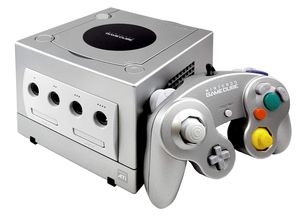
Gamecube Console Platinum
For starters, Nintendo has quite clearly made this a game-only machine. It doesn't try to play your CD collection, run your movies, read your e-mail, or store your MP3 files. The company has concentrated its efforts on games. All the prelaunch titles we've seen play smoothly, with bright, fast graphics and great sound. Nintendo says its engineers have removed traditional bottlenecks that have, in the past, slowed down processing. New components designed by IBM and MoSys, as well as a large-capacity secondary memory cache, keep instructions moving through the system's microprocessor (MPU) at peak levels. In English: the GameCube is optimized to push speed up while pushing costs down; hence its position at the lower end of the price spectrum.
The GameCube is the first Nintendo video game system to use a disc-based medium rather than cartridges for its games. Moving the software to disc media generally means lower development costs for the publishers, which, in turn, trickles down to the consumer not only in price, but also in availability and quality, as it's then easier to try out untested game ideas (Pikmin, anyone?). While most other systems likewise have their games stored on discs, the GameCube's 3-inch format is smaller than everyone else's, and is so designed to fit in a shirt pocket as much as to deter would-be software pirates.
Of course, the main advantage of the GameCube is that it's the home field of one of the world's premier game designers: Nintendo. While powerhouses Electronic Arts and Sega make games for all systems (including this one), you can play Nintendo games only on a Nintendo system. And Nintendo, you
in next 2 weeks