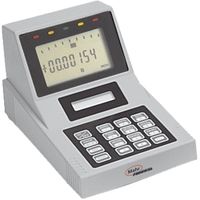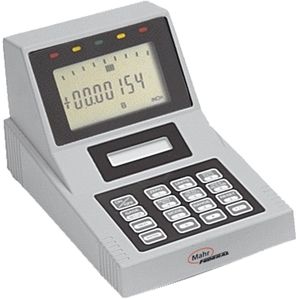
The Mahr Millitron 832 electronic amplifier is battery-operated and accepts 120 VAC input power, and is intended for use with Mahr Federal-style inductive probes (sold separately) in measuring lengths. It measures in increments as small as 0.000001" and 10 arc seconds. Three selectable ranges (+/- 0.100, 0.010, and 0.001 inches) and use with two inductive probes and one pneumatic probe allow dynamic measurements based on MAX, MIN, MAX-MIN, and (MAX+MIN)/2. It has analog and one-line digital displays, automatic range selection, and linear and angular results. The amplifier has an operating temperature range of 40 to 110 degrees F. Its menu-driven setup displays English, French, or Spanish language, and its keypad controls power and measurement functions. The RS-232 output allows connection to data-collecting devices, such as a controller or computer. This electronic amplifier is suitable for use in a variety of linear and angular measurement applications, such as the concentricity of two machined shafts or step height of a stepped piece.
Indicator gauges, also called gages or dial indicators, are precision instruments that measure short linear distances. They are commonly used for detecting deviations from tolerance limits, such as the amount of surface distortion, or runout, on a round or cylindrical workpiece. They have two styles: digital indicator gauges and dial indicator gauges. Digital indicator gauges use an electronic sensor and display measurement through an LCD or other digital display. Dial indicator gauges measure through a spring-loaded plunger driven into its shaft. The pointer on the dial display marks the degree the plunger is depressed, while an additional turn counter may track the number of times the pointer has spun around the dial. For all types of indicator gauges, runout is typically measured when the tip of the plunger (the point) is held perpendicular to the rotating workpiece. Indicator gauges are typically used
Mahr Federal Millitron 832 Federal-Style Probe Electronic Amplifier, 120 VAC or Battery
The Mahr Millitron 832 electronic amplifier is battery-operated and accepts 120 VAC input power, and is intended for use with Mahr Federal-style inductive probes (sold separately) in measuring lengths. It measures in increments as small as 0.000001" and 10 arc seconds. Three selectable ranges (+/- 0.100, 0.010, and 0.001 inches) and use with two inductive probes and one pneumatic probe allow dynamic measurements based on MAX, MIN, MAX-MIN, and (MAX+MIN)/2. It has analog and one-line digital displays, automatic range selection, and linear and angular results. The amplifier has an operating temperature range of 40 to 110 degrees F. Its menu-driven setup displays English, French, or Spanish language, and its keypad controls power and measurement functions. The RS-232 output allows connection to data-collecting devices, such as a controller or computer. This electronic amplifier is suitable for use in a variety of linear and angular measurement applications, such as the concentricity of two machined shafts or step height of a stepped piece.
Indicator gauges, also called gages or dial indicators, are precision instruments that measure short linear distances. They are commonly used for detecting deviations from tolerance limits, such as the amount of surface distortion, or runout, on a round or cylindrical workpiece. They have two styles: digital indicator gauges and dial indicator gauges. Digital indicator gauges use an electronic sensor and display measurement through an LCD or other digital display. Dial indicator gauges measure through a spring-loaded plunger driven into its shaft. The pointer on the dial display marks the degree the plunger is depressed, while an additional turn counter may track the number of times the pointer has spun around the dial. For all types of indicator gauges, runout is typically measured when the tip of the plunger (the point) is held perpendicular to the rotating workpiece. Indicator gauges are typically used
in next 2 weeks
By clicking "Accept All", you consent to our use of cookies.