Description
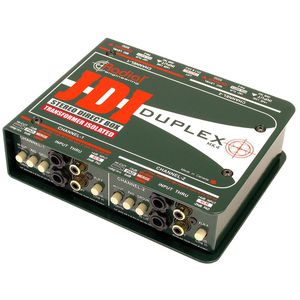
The Radial JDI Duplex Mk4 is a full-featured passive DI designed to enhance connectivity for the touring professional and AV integrator. The Duplex comes equipped with 1/4" connectors for -10dB consumer electronics and XLR inputs for +4dB professional line sources. Like the Radial JDI, the Duplex employs two high-performance 'made in the USA' audio transformers and the same pristine audio signal path that has made the JDI the industry standard. It features exceptional signal handling with virtually zero phase shift or harmonic distortion, while remaining linear across the entire audio spectrum. Natural transformer saturation and warm Bessel curve makes the Radial Duplex the perfect choice for rounding out highly dynamic instruments, like digital keyboards, that can sound harsh when driven hard. Transformer isolation also provides the benefit of eliminating troublesome ground loops that can cause hum and buzz and can interfere with video displays. Radial's innovative 'book-end' design provides protective zones that shield connectors and switches from the abuses of professional touring . A welded I-beam inner frame is designed to eliminate outside stresses that could torque the PC board and cause premature solder point and trace failure. A 14-gauge steel shell couples with the mu-metal transformer shield to eliminate stray magnetic field interference from power transformers and a full-bottom no-slip pad provides plenty of stay-put and helps reduce electrical coupling from amplifier chassis hardware. The Radial Engineering JDI Duplex Features:
Radial Engineering Duplex
Current Price
$349.99
Average
$349.99
Min Price
$349.99
Max Price
$349.99
Price dynamics
0%
Description
The Radial JDI Duplex Mk4 is a full-featured passive DI designed to enhance connectivity for the touring professional and AV integrator. The Duplex comes equipped with 1/4" connectors for -10dB consumer electronics and XLR inputs for +4dB professional line sources. Like the Radial JDI, the Duplex employs two high-performance 'made in the USA' audio transformers and the same pristine audio signal path that has made the JDI the industry standard. It features exceptional signal handling with virtually zero phase shift or harmonic distortion, while remaining linear across the entire audio spectrum. Natural transformer saturation and warm Bessel curve makes the Radial Duplex the perfect choice for rounding out highly dynamic instruments, like digital keyboards, that can sound harsh when driven hard. Transformer isolation also provides the benefit of eliminating troublesome ground loops that can cause hum and buzz and can interfere with video displays. Radial's innovative 'book-end' design provides protective zones that shield connectors and switches from the abuses of professional touring . A welded I-beam inner frame is designed to eliminate outside stresses that could torque the PC board and cause premature solder point and trace failure. A 14-gauge steel shell couples with the mu-metal transformer shield to eliminate stray magnetic field interference from power transformers and a full-bottom no-slip pad provides plenty of stay-put and helps reduce electrical coupling from amplifier chassis hardware. The Radial Engineering JDI Duplex Features:
Price will be lower
in next 2 weeks
in next 2 weeks
According to the data, price will be lower in next two weeks, so not waste your money and track better price!
Product review & video
welcome back to JLB productions Bruno Lucia thanks for joining me now I recently received this comment from a viewer by the name of Oscar Mike and this was on my di boxes pot 5 video Oscar writes I have a question I'm looking for the most universal di box possible on the market I'd like to use it for my active acoustic guitar for an electric bass guitar electric guitar using an amplifier and often with some effects pedals attached all keyboards but also various technical purposes like playing music from an audio device or a backing track from a USB audio interface with two simple left/right outputs so it means mono but sometimes also stereo di box what would you recommend for my situation an active di or a passive di alright so first of all Thank You Oscar for your question Oscar's question brings up the issue of mono vs. stereo di boxes which I have not covered before on this channel s