- HomeElectronicsCamera & PhotoBinoculars & ScopesMicroscopesCompound MicroscopesCompound Binocular Microscopes
Description
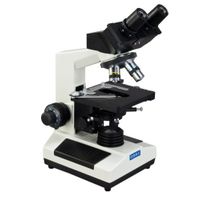
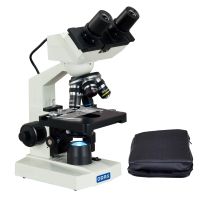
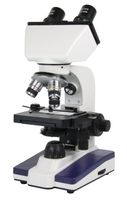
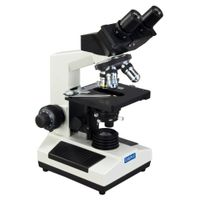
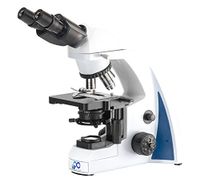
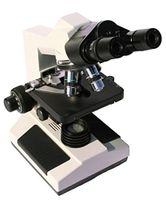
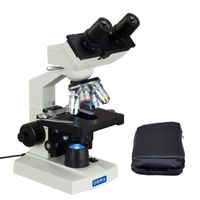
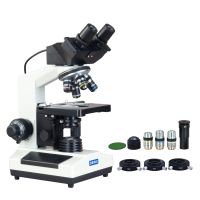
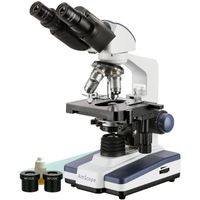
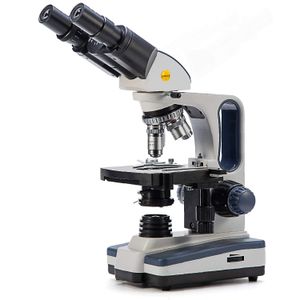
The Swift SW350B is a workhorse of a compound binocular microscope, providing incredibly sharp magnification and ergonomic usability. Designed as a powerful tool for clinical, laboratory, and educational use, the SW350B is suitable for high school, university, and medical students as well as the seasoned professional.
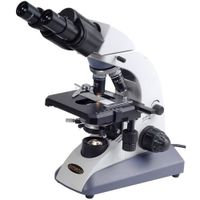
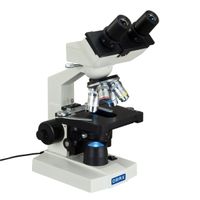
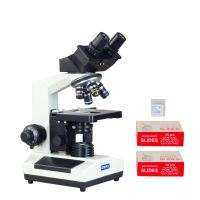
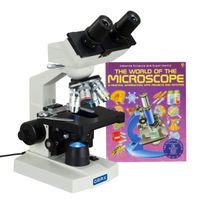
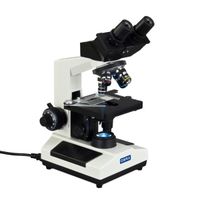
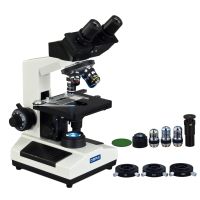
Features a Siedentopf binocular head that rotates 360 degrees for easy shared use and allows for quick adjustments to the eyepieces for different interpupillary distances without losing focus. The swiveling head can also lock in any position for additional stability. Ocular tubes are tilted at an ergonomic 30 degrees to reduce neck and eye strain. The microscope comes with two interchangeable widefield 10X and 25X glass ocular eyepieces, which pair with the four achromatic DIN objectives -- 4X, 10X, 40X(Spring), and 100X(Spring, Oil) -- in the rotating nosepiece to provide 6 magnification levels between 40X and 2500X. Coarse and fine focusing dials on both sides of the metal arm make fluid and exact precision adjustments.
For specimen viewing, an LED bulb beneath the stage transmits light up through an industry-standard Abbe condenser with 1.25 aperture and an iris diaphragm. Manually move the condenser closer to or farther from the stage to adjust brightness and evenness of light as well as image contrast. A metal slide holder locks specimens into place for viewing on the sizeable double-layered mechanical stage. An x-y translational control knob moves the stage and the slide holder left-to-right and front-to-back, eliminating the need to re-clip slides in order to view the entire specimen.
The SW350B has a compact but solid body that is nonetheless easily portable with the built-in arm handle.
What can you see with it? Compound microscopes offer detailed, cellular-level views of transparent or dyed specimens prepared and mounted on a slide. (For magnifying solid objects, use a stereo microscope.)
Features a Siedentopf binocular head that rotates 360 degrees for easy shared use and allows for quick adjustments to the eyepieces for different interpupillary distances without losing focus. The swiveling head can also lock in any position for additional stability. Ocular tubes are tilted at an ergonomic 30 degrees to reduce neck and eye strain. The microscope comes with two interchangeable widefield 10X and 25X glass ocular eyepieces, which pair with the four achromatic DIN objectives -- 4X, 10X, 40X(Spring), and 100X(Spring, Oil) -- in the rotating nosepiece to provide 6 magnification levels between 40X and 2500X. Coarse and fine focusing dials on both sides of the metal arm make fluid and exact precision adjustments.
For specimen viewing, an LED bulb beneath the stage transmits light up through an industry-standard Abbe condenser with 1.25 aperture and an iris diaphragm. Manually move the condenser closer to or farther from the stage to adjust brightness and evenness of light as well as image contrast. A metal slide holder locks specimens into place for viewing on the sizeable double-layered mechanical stage. An x-y translational control knob moves the stage and the slide holder left-to-right and front-to-back, eliminating the need to re-clip slides in order to view the entire specimen.
The SW350B has a compact but solid body that is nonetheless easily portable with the built-in arm handle.
What can you see with it? Compound microscopes offer detailed, cellular-level views of transparent or dyed specimens prepared and mounted on a slide. (For magnifying solid objects, use a stereo microscope.)
Swift SW350B 40X-2500X Magnification, Siedentopf Binocular Head, Research-Grade Compound Lab Microscope with Wide-Field 10X and 25X Eyepieces, Mechanical Stage, Abbe Condenser
Current Price
$209.99
Average
$193.55
Min Price
$169.99
Max Price
$209.99
Price dynamics
8%
Description
The Swift SW350B is a workhorse of a compound binocular microscope, providing incredibly sharp magnification and ergonomic usability. Designed as a powerful tool for clinical, laboratory, and educational use, the SW350B is suitable for high school, university, and medical students as well as the seasoned professional.
Features a Siedentopf binocular head that rotates 360 degrees for easy shared use and allows for quick adjustments to the eyepieces for different interpupillary distances without losing focus. The swiveling head can also lock in any position for additional stability. Ocular tubes are tilted at an ergonomic 30 degrees to reduce neck and eye strain. The microscope comes with two interchangeable widefield 10X and 25X glass ocular eyepieces, which pair with the four achromatic DIN objectives -- 4X, 10X, 40X(Spring), and 100X(Spring, Oil) -- in the rotating nosepiece to provide 6 magnification levels between 40X and 2500X. Coarse and fine focusing dials on both sides of the metal arm make fluid and exact precision adjustments.
For specimen viewing, an LED bulb beneath the stage transmits light up through an industry-standard Abbe condenser with 1.25 aperture and an iris diaphragm. Manually move the condenser closer to or farther from the stage to adjust brightness and evenness of light as well as image contrast. A metal slide holder locks specimens into place for viewing on the sizeable double-layered mechanical stage. An x-y translational control knob moves the stage and the slide holder left-to-right and front-to-back, eliminating the need to re-clip slides in order to view the entire specimen.
The SW350B has a compact but solid body that is nonetheless easily portable with the built-in arm handle.
What can you see with it? Compound microscopes offer detailed, cellular-level views of transparent or dyed specimens prepared and mounted on a slide. (For magnifying solid objects, use a stereo microscope.)
Features a Siedentopf binocular head that rotates 360 degrees for easy shared use and allows for quick adjustments to the eyepieces for different interpupillary distances without losing focus. The swiveling head can also lock in any position for additional stability. Ocular tubes are tilted at an ergonomic 30 degrees to reduce neck and eye strain. The microscope comes with two interchangeable widefield 10X and 25X glass ocular eyepieces, which pair with the four achromatic DIN objectives -- 4X, 10X, 40X(Spring), and 100X(Spring, Oil) -- in the rotating nosepiece to provide 6 magnification levels between 40X and 2500X. Coarse and fine focusing dials on both sides of the metal arm make fluid and exact precision adjustments.
For specimen viewing, an LED bulb beneath the stage transmits light up through an industry-standard Abbe condenser with 1.25 aperture and an iris diaphragm. Manually move the condenser closer to or farther from the stage to adjust brightness and evenness of light as well as image contrast. A metal slide holder locks specimens into place for viewing on the sizeable double-layered mechanical stage. An x-y translational control knob moves the stage and the slide holder left-to-right and front-to-back, eliminating the need to re-clip slides in order to view the entire specimen.
The SW350B has a compact but solid body that is nonetheless easily portable with the built-in arm handle.
What can you see with it? Compound microscopes offer detailed, cellular-level views of transparent or dyed specimens prepared and mounted on a slide. (For magnifying solid objects, use a stereo microscope.)
Price will be lower
in next 2 weeks
in next 2 weeks
According to the data, price will be lower in next two weeks, so not waste your money and track better price!
Product review & video
so hi hello and welcome microbehunter here again and today i'd like to do another review video what i have here is the swift sw 380 t microscope and i think it could be quite an interesting microscope to have a closer look at if you're interested in amateur microscopy um or maybe if you're looking for a microscope for educational use in a school and i think it's suitable because the quality is quite high and also it does not cost all too much and what i would like to do in this video is i'd like to um of course show you the different parts of the microscope i mean it's got the standard features so there's no surprises here and later on i'd like to also do a little bit of an unpacking so i'm going to show you what can be found inside the box and then at the very end i'm going to connect the camera to the microscope and then we're going to have a closer look at some of the specimens um wh